Accounts Receivable Collection: When to Pause New Work
November 15, 2026. Updated November 15, 2026
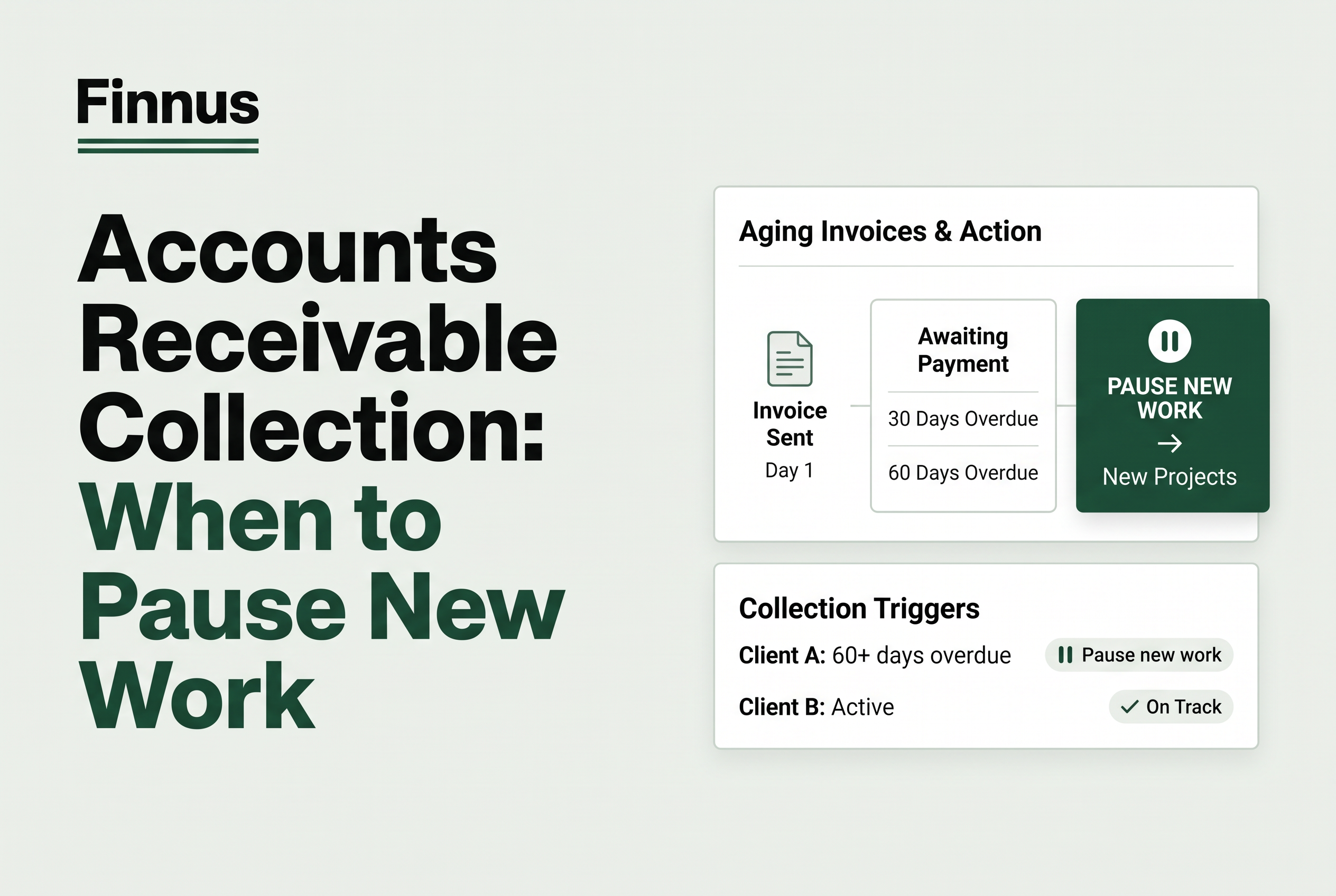
Accounts receivable collection works best as an owner operating decision, not a bookkeeping task: read the aging report by bucket, give every overdue invoice one named owner, separate disputes from slow payers, and write down the point at which you stop taking on new work for that customer.
Most trade and service owners do some of this by feel. They chase the big invoices when cash gets tight and let the small ones age. The problem is that feel changes with your mood and your bank balance. A written rule doesn't. This guide walks through the steps in order, from reading the aging report to deciding when an invoice leaves your hands. Your contract and your lawyer decide what you may do about suspending work, late fees or formal collection.
What happens when accounts receivable go uncollected
When accounts receivable go uncollected, you have already paid for the labor, materials and fuel. The cost of the job sits on your books while the cash sits with your customer. Payroll, suppliers and your own distributions still come due on schedule.
The second cost is quieter. A customer who learns that a late invoice produces no consequence has little reason to pay the next one on time. Overdue balances also tend to grow, because the same customer keeps ordering work while the old invoices sit.
The longer an invoice ages, the harder it is to collect. Memories fade, the person who approved the job leaves, and the customer's attention goes to whoever is chasing them hardest. Every week of delay is a decision you are making by default.
If you are not sure how much unpaid work your business can carry, start with working capital requirements to see how much cash you need tied up in jobs before overdue invoices become a problem.
Read your aging report by bucket and assign a next action
An accounts receivable aging report groups every unpaid invoice by how many days it is past due, and the useful version attaches a next action to each group. The standard buckets are current, 1 to 30 days, 31 to 60, 61 to 90 and over 90 days overdue.
One rule matters more than the rest: count days overdue from the due date, not the invoice date. An invoice issued 45 days ago on net 30 terms is 15 days late, not 45.
For each open invoice, track the customer, invoice number, due date, balance, days overdue, dispute status, last contact and next action. Reconcile the total to your accounting records so you trust the numbers.
Here is a working action for each bucket:
Before due date and 1 to 30 days: Send a courteous reminder and confirm the customer received the invoice. Ask whether they need anything to process payment.
31 to 60 days: Call the customer directly, find any paperwork problem or dispute, and ask for a specific payment date. Send an updated statement.
61 to 90 days: Escalate to the decision-maker, send a firmer written notice and consider a documented payment arrangement.
Over 90 days: Review whether the balance is collectible and decide among a collection agency, legal advice or a write-off review.
Review the report weekly if cash is tight, and at least monthly otherwise. Look at the oldest and largest balances first. A report that only summarizes balances is a record. One that lists the next action and date is a tool.
Who owns each overdue invoice: office, manager or you
Every overdue invoice needs exactly one named owner, because an invoice that belongs to "the office" belongs to nobody. Split ownership by bucket and by size so the right person is making each call.
A workable split: office staff own reminders and statements in the 1 to 30 day bucket. An operations manager or service manager owns the 31 to 60 day calls, since they know the job and the customer contact. You step in at 61 days, or when a single balance is large enough to hurt your cash position, and for any account where the relationship matters beyond one invoice.
Write the owner's name next to each invoice on the aging report, along with the date of the next contact. Then hold a short weekly check: for each overdue invoice, did the owner do what the report said they would do?
This also settles a common conflict. The person who sold or ran the job often hesitates to push for payment because they want the next job. Giving early-stage collection to someone with no stake in the relationship keeps the pressure steady. Your job is to be the escalation point, not the first caller on every invoice.
Separate disputes from slow payers before you escalate
A dispute and a slow payer are different problems, and treating them the same way costs you either the customer or the money. A dispute means the customer disagrees with the work, the price or the paperwork. A slow payer accepts the invoice but is not paying on time.
Sort every overdue invoice into one of these before you escalate:
Slow payer: The customer agrees they owe it. The fix is a firm date, a reminder cadence and a consequence you are willing to apply.
Dispute: The customer questions something specific. The fix is to find out what, resolve it quickly and invoice the corrected amount if needed. Pressing for payment on a disputed invoice usually hardens the position.
Paperwork block: The customer is willing to pay but needs a PO number, a lien waiver, a signed completion form or a different billing contact. This is the cheapest category to fix and the one most often missed.
Ask one direct question on the first call: "Is there anything about this invoice or the work that you disagree with?" A clear no turns the invoice into a slow payer problem and removes the excuse later. A clear yes gives you something concrete to resolve, and a record of what was said.
Log every contact and every promise. A promise to pay by Friday that is not kept is information you will want when you decide what comes next. Before you suspend work, add fees or involve anyone outside the company, make sure the invoice is actually due and not under a genuine dispute, and check your contract.
Payment plans that keep cash coming without losing leverage
A payment plan is worth offering when the customer wants to pay and cannot do it all at once, and it only works if it is written down and has teeth. Offer it in the 61 to 90 day bucket, or earlier if the customer asks.
Keep the terms plain: the total owed, the amount and date of each installment, and what happens if one is missed. Get the customer's agreement in writing, by email at minimum. Ask for a first payment right away. A plan that starts with a payment today is much more likely to finish than one that starts next month.
Decide in advance whether you will keep working for this customer while the plan runs. That is a business decision, not a collections one. If the plan covers old invoices and the customer is paying new work on time, continuing may be reasonable. If new invoices are also going unpaid, the plan is not solving the problem.
A missed installment is your signal. Don't let it slide even once. Contact the customer the same day, restate the agreement and ask for the payment. If a plan lapses twice, treat the account as a candidate for your pause trigger.
If you are weighing whether to give customers longer terms up front, Net 60 terms: who can approve longer payment deadlines covers that decision separately.
When to pause new work: write the trigger before you need it
Pause new work for a customer when an undisputed invoice stays unpaid past a threshold you wrote down in advance, not when you are angry or short on cash. Write the trigger first because it takes the emotion out of a decision you will otherwise make badly.
First, check your contract and get legal advice. Payment terms say when an invoice is due. They don't necessarily give you the right to stop work. A suspension clause normally has to say what triggers it, what written notice is required, how long the customer has to fix it, which work can pause and how restarting works. If your contract has no suspension right, stopping work could itself be a breach, and construction work may be covered by specific notice and payment rules where you operate.
With that confirmed, a trigger has four parts:
Condition: An undisputed invoice is more than a set number of days past due, or the customer's total overdue balance passes a dollar limit.
Notice: A written warning that new work will not be scheduled until the account is brought current.
Scope: Which jobs the pause covers, for example new quotes and new scheduling but not safety-critical work already in progress.
Restart: What the customer must pay before work resumes.
Choose the day count and dollar limit based on your cash position, not on a number from an article. A $40,000 balance means something different to a $6M business than to a $25M one.
Put the trigger in your customer terms for new accounts and review it with your manager so nobody makes an exception on the phone. To check how much a single customer's balance can swing your cash, see revenue concentration limits.
When to send an invoice to collections, small claims or a write-off review
Move an invoice out of your own hands when your internal steps are exhausted and the balance is worth more than the cost and time of pursuing it. For most owners, that is when an invoice passes 90 days overdue with no payment plan and no active dispute.
You have three exits, and the right one depends on the amount, the customer and your contract:
Collection agency: Useful when you have a clear, undisputed debt and no plan to work for the customer again. Agencies typically keep a share of what they recover, so ask about fees before you hand anything over.
Small claims court: Worth considering for balances within your state's small claims limit, with good documentation. Limits and procedures vary by state, so confirm yours.
Write-off review: Sometimes the honest answer is that the money is not coming. Review the invoice, document why, and take it off your active list so it stops distorting your numbers. Talk to your accountant about the tax treatment.
Before any of these, talk to a lawyer. Deadlines, notice requirements and what you can add in fees or interest depend on your contract and your state. Don't assume you have a right your contract doesn't give you.
Also decide whether the customer is still welcome. Sending a collections letter and quoting their next job in the same month sends mixed signals. Pick a direction.
Prevent the next late payer: terms, deposits and a monthly receivables review
The cheapest accounts receivable collection is the invoice that never goes late, and prevention comes down to clear terms, cash up front where it makes sense and a regular look at the numbers.
Start with terms that state the due date, accepted payment methods and what happens when an invoice is late. If you want to charge late fees or interest, put them in your written terms before the work starts and check with a lawyer that they are allowed where you operate. A fee you invented after the invoice went late is much harder to collect.
Then use deposits. For jobs with material costs, a deposit means you are not financing the customer's project. Customer deposits: cover materials before work starts walks through how to size them.
Send a reminder before the due date, not only after it. A short note works:
Subject: Invoice [number] due [date] Hi [name], a quick reminder that invoice [number] for $[amount] is due on [date]. Let us know if you need anything from us to process it. Thank you.
After the due date, keep the same tone and add the specific ask: "Can you confirm a payment date?"
Finally, make a monthly receivables review part of how you run the business. Look at the aging buckets, the named owners, disputes versus slow payers and any customer near your pause trigger. The monthly business review agenda is a good place to add it.
Finnus is an experienced operating partner for owner-run businesses of roughly $5M to $30M in revenue, with monthly board meetings and a lasting decision record. A pause trigger you wrote once stays written down and gets reviewed instead of forgotten.
Write your pause trigger this week, then bring it to a board meeting
Overdue invoices stay overdue when nobody owns them and nobody has decided what the limit is. This week, pull your aging report, put one name next to every invoice over 30 days, and write down the day count and dollar balance at which you stop scheduling new work for a slow payer, after checking your contract and speaking with a lawyer. Then take the decision to Finnus: start with the free 30-minute intro call, bring the trigger and your worst aging account, and leave with an outside view from an experienced operating partner.
Frequently asked questions
How do I handle overdue invoices in a service business?
Sort them by how many days past due they are, give each one a named owner and set a next action per bucket: reminder at 1 to 30 days, direct call at 31 to 60, decision-maker escalation at 61 to 90, and a collectibility review beyond 90. Separate disputes from slow payers first. Finnus helps owners set these rules and review them monthly.
When should I send an overdue invoice to collections or small claims court?
Consider it when an undisputed invoice is well past 90 days, your reminders and any payment plan have failed, and the balance justifies the cost. Collection fees, small claims limits and notice rules vary, so check your contract and get legal advice first. A write-off review is a third option when recovery looks unlikely.
What are the 5 C's of accounts receivable management?
The 5 C's are usually listed as character, capacity, capital, collateral and conditions, the factors used to judge whether a customer will pay. For a trade business, that means checking payment history, ability to pay, financial strength, any security and the job's circumstances before extending terms. Finnus can help you turn them into credit rules for new accounts.
Can I charge late fees or interest on overdue invoices?
Only if your written terms say so before the work starts, and the rules where you operate allow it. Check your contract and ask a lawyer before adding fees to an existing invoice. Clear terms stating the due date and consequences also make reminders easier. Finnus can help you review your terms as part of a monthly operating review.
Should I stop working for a customer who hasn't paid?
Not automatically. First confirm the invoice is due and not genuinely disputed, then check whether your contract gives you a right to suspend and what notice it requires. If it does, follow that process. If it does not, get legal advice before pausing, since stopping could itself breach the agreement.
Talk it through with an operating partner who remembers every decision.
Book an intro call