Early Payment Discount: Is Faster Cash Worth the Cost?
November 7, 2026. Updated November 7, 2026
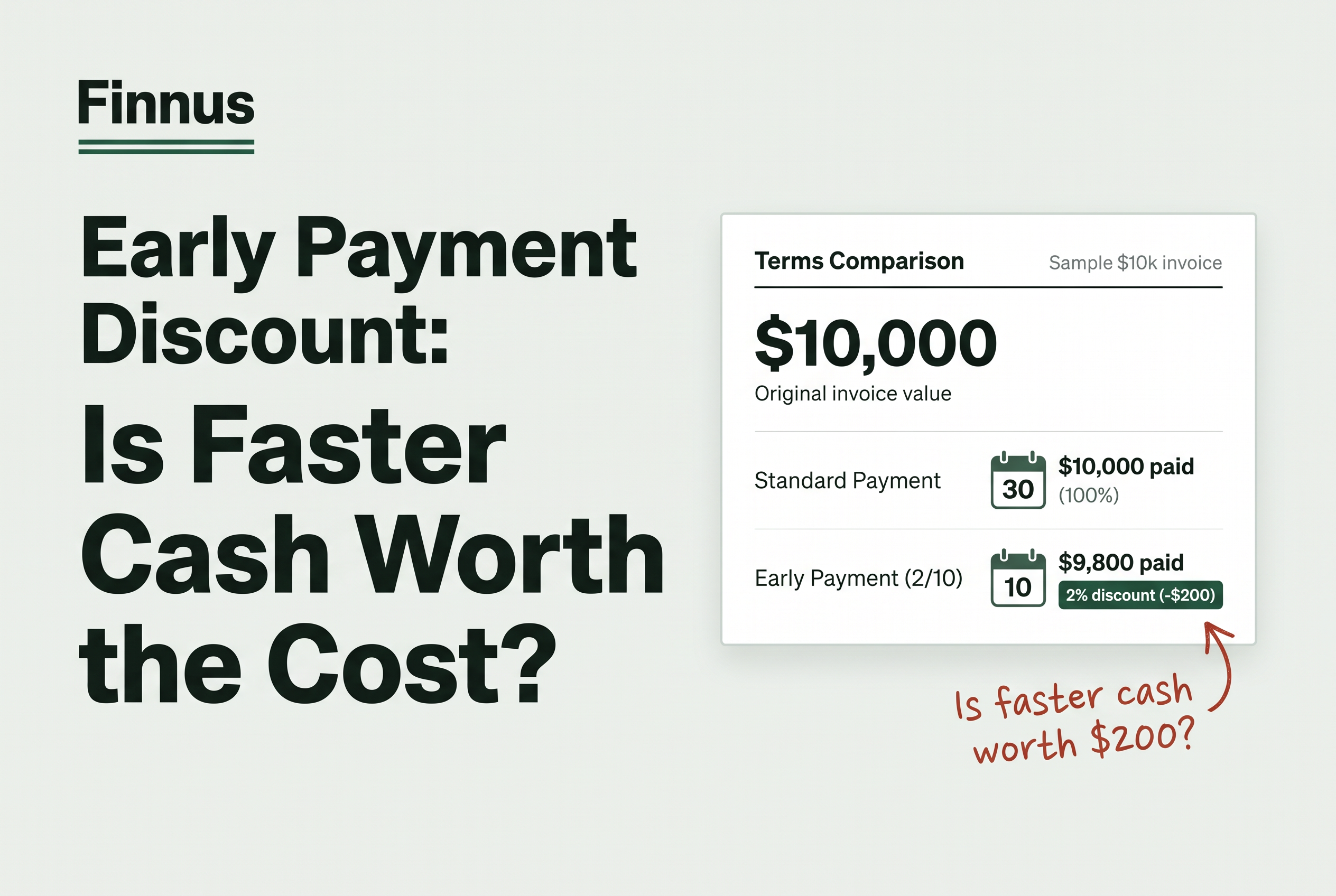
Offer an early payment discount only when the cash it brings in sooner is worth more than the margin you give up. For most service and trade businesses, that bar is higher than it looks. A 2% discount that moves payment from day 30 to day 10 costs roughly 37% annualized, and because the discount comes off your price and not off your profit, the hit to margin is bigger than 2%.
This guide is for the seller's side: owners of service, trade and project businesses who invoice on net 30 or longer and are deciding whether to give customers a reason to pay early. Every calculation below uses clearly labelled illustrative numbers, so swap in your own. Finnus is an experienced operating partner for owner-run businesses, and a decision like this one is the kind of thing owners bring to a monthly board meeting before changing terms.
What an early payment discount is (and how to read 2/10 net 30)
An early payment discount is a price reduction you give a customer for paying an invoice before its due date. The standard shorthand is 2/10 net 30: the customer may deduct 2% if they pay within 10 days, otherwise the full amount is due in 30.
Read it as three numbers. The 2 is the discount percentage. The 10 is the discount window. The 30 is the normal due date. The gap between day 10 and day 30 is the only thing you are buying: 20 days of faster cash.
For the long-term picture of how terms like this fit into planning, a cash flow forecast shows whether those 20 days matter to your business or just feel good.
A quick answer to a common search: "early payment" means the customer pays before the standard due date on the invoice. It does not mean paying at the moment of the job unless your terms say so.
How to calculate the real cost: discount, days gained and annualized rate
The prompt payment discount formula is: annualized cost = discount / (1 minus discount) x 365 / (net days minus discount days). For 2/10 net 30, that is 0.02 / 0.98 x 365 / 20, which comes to about 37.2% on a simple 365-day basis (a widely used finance formula).
Here is what that means. You are paying a 37% annual rate to get paid 20 days sooner. If your line of credit costs 10% to 12%, you are overpaying for that money by a wide margin.
Illustrative example, not a customer result: you invoice $20,000 on 2/10 net 30. A customer who takes the discount pays $19,600 on day 10. You gave up $400 to collect 20 days early. If that customer would have paid on day 30 anyway, the $400 bought you nothing but a smaller invoice.
To calculate a simple discount, multiply the invoice by the discount rate: $20,000 x 2% = $400. The formula for the discounted payment is invoice x (1 minus rate), so $20,000 x 0.98 = $19,600.
Then check the days. Many customers already pay on day 45 or day 60, not day 30. If your real average collection time is 52 days and a discounted customer pays on day 10, you gained 42 days, not 20, and the annualized rate drops sharply. Use your actual days sales outstanding, not the number printed on the invoice.
Invoice discount vs gross margin: why 2% off can cost far more than 2% of profit
A 2% invoice discount can cost 8% or more of your profit on that job, because the discount comes straight off the price while your costs stay the same. Keep the invoice discount and the gross margin percentage as two separate numbers.
Illustrative example, not a benchmark: a job is invoiced at $20,000 with a 25% gross margin, so $5,000 of gross profit. A 2% discount removes $400. Gross profit falls to $4,600, a drop of 8% in profit dollars, and the margin percentage on the discounted invoice slips to 23.5%. The discount rate was 2%. The profit hit was 8%.
The thinner your margin, the worse this gets. At a 15% gross margin, the same $400 takes out 13.3% of your gross profit. At a 10% margin it takes out 20%.
So before you offer any discount, write down your gross margin by job type. A discount that is tolerable on a 40% margin product line can be punishing on a competitive bid job where you cleared 12%.
If your pricing is already under pressure, fix that first. A service business pricing strategy that protects margin makes every later discount decision easier.
Compare equivalent cash periods: discount vs line of credit vs customer deposits
To compare options fairly, price each one over the same cash period. Here the period is 20 days: the cash you would receive on day 10 instead of day 30 on a $20,000 invoice.
Illustrative comparison, using assumed rates:
| Option | Cost for 20 days on $20,000 | Annualized | Control |
|---|---|---|---|
| 2/10 net 30 discount | $400 | about 37% | Customer decides |
| Line of credit at an assumed 11% | about $120 | 11% | You decide |
| Customer deposit | Often no financing cost | n/a | You set it before work starts |
The line of credit figure is $20,000 x 11% x 20/365, about $120. That assumed rate is an example, not a quote. Use your own bank terms.
The discount is the most expensive of the three and the one you control least, because the customer chooses whether to take it. A line of credit costs less when you only need a short bridge. A deposit costs the least, because it moves cash forward without cutting your price at all. If materials drive your cash gap, read our guide on customer deposits before you cut a single invoice.
The discount wins only when you have no cheaper source of cash, or when you want to pull a slow-paying customer forward and they would otherwise pay on day 60 or later.
Collection risk: customers who take the discount but pay late, and who you should not offer it to
The biggest risk is the customer who deducts the discount and still pays late. You lose the margin and you don't get the speed. Early payment discounts don't guarantee prompt payment, and they can erode margin when customers take the deduction without meeting the deadline.
Set the rule in writing: the discount applies only if payment arrives by the discount date. Decide in advance what you do when a customer short-pays on day 25 with the discount deducted. Many owners let it slide once, then it becomes the new norm.
Who should not get the offer:
Customers who already pay early. You would be paying them for what they do for free.
Customers who are slow because of their own approval process. A 2% carrot rarely fixes a procurement queue.
Customers on thin-margin jobs where the discount wipes out most of the profit.
Customers who make up a large share of revenue. A discount becomes a standing price cut on your biggest account. See revenue concentration limits before you extend it.
The best candidates are mid-sized, reliable customers who pay on day 40 to 60 and have the cash to pay sooner if given a reason. If you are weighing longer terms for a large account, Net 60 terms covers who should approve them. This article is general business information, not legal or tax advice. Check how a discount affects your invoices and records with your accountant.
How much cash do you need? A decision test before you offer terms
Offer a discount only if you can name the cash gap it closes and its cost is below your cheapest alternative. Run this four-step test.
Find your gap. Build a 13-week view of cash in and cash out. If you never dip near your minimum cash balance, you don't need faster cash, and a discount is just a price cut.
Price the gap. Estimate how many dollars you would borrow, for how many days, at what rate. That is the ceiling on what a discount is worth.
Estimate uptake. If 40% of customers take a 2% discount on $2 million of annual invoices you would have collected anyway, the cost is $16,000 a year (illustrative: $2,000,000 x 40% x 2%). Compare that with the financing cost you avoided.
Check margin. Run the discount against your gross margin by job type, as above.
If the discount costs more than the borrowing it replaces, skip it. If it is close, test it narrowly. If you do need to bridge a recurring gap, owner distributions and hiring plans draw on the same cash, so protect a floor first, as in owner distributions.
Which cash flow forecasting method should I use before offering a discount?
Use a 13-week direct forecast: list the invoices you expect to collect each week, then subtract payroll, materials, taxes and debt payments. Run it twice, once at your current average collection days and once with a share of customers paying in 10 days. The gap between the two lines shows how much cash the discount frees up, and whether you need it at all. If your lowest weekly balance stays comfortable under current terms, the discount is probably a cost without a need.
How to run a pilot and review it monthly (with Finnus as an outside view)
Run a small pilot before you change terms for everyone. Pick 5 to 10 customers who fit the profile above, offer the discount for 90 days, and track four numbers each month: discount dollars given, average days to pay for discount customers, the share who took the deduction but paid late, and your cash balance against your minimum.
Hold a comparison group on standard terms so you can see whether the discount sped anything up. If discount customers pay on day 12 and your comparison group pays on day 40, the speed gain is real. If both groups pay around day 35, you bought nothing.
Set a stop rule before you start. For example, end the pilot if late discount-takers exceed 15% or if the cost per day gained is above your line of credit cost. A monthly business review agenda keeps this on the calendar so it doesn't drift.
This is where an outside view helps. Finnus is an experienced operating partner for owner-run businesses, with monthly board meetings and a lasting decision record. Bring the pilot numbers to a meeting, get a second opinion on whether to extend, tighten or end the offer, and keep a record of why you decided. Finnus Board is $999/month with a three-month minimum, and the first step is a free 30-minute intro call where you bring a decision and leave with an outside view.
FAQ: prompt payment discount formula, examples and what 'early payment' means
The FAQ below answers the questions owners search most. The formula, a worked example and the meaning of early payment are all covered there, using the same illustrative numbers as above so you can check your own invoices against them.
Price the cash gap first, then decide on the discount
Faster cash is worth buying only when you can name the gap it fills and the price is below your next cheapest source. For most owners on net 30, a 2/10 discount costs around 37% annualized and takes more profit than the headline percentage suggests, so deposits or a short credit line usually win. Test the offer on a handful of reliable customers, measure the days actually gained, and stop it if the numbers don't hold. Bring your invoice terms, margins and pilot results to a free 30-minute intro call with Finnus and leave with an outside view before you change terms for every customer.
Frequently asked questions
How is a prompt payment discount calculated?
Multiply the invoice by the discount rate to get the dollars given up, then subtract it from the invoice. On a $20,000 invoice at 2%, the discount is $400 and the customer pays $19,600. To judge the cost, use discount / (1 minus discount) x 365 / (net days minus discount days), which gives about 37.2% for 2/10 net 30.
What does 'early payment' mean?
Early payment means a customer pays an invoice before its standard due date. Under 2/10 net 30, paying by day 10 counts as early and earns the 2% discount, while paying on day 11 through 30 is on time at full price. It is the customer's action that triggers the discount, so your terms should state the exact deadline.
Can you give me some examples of discount offers?
Common examples are 2/10 net 30 (2% off if paid in 10 days), 1/15 net 45 (1% off if paid in 15 days) and 3/7 net 30 for tighter cash needs. Illustratively, a 1/15 net 45 offer on $10,000 saves the customer $100 and costs you $100 for 30 days of faster cash. Test any offer on a few customers first.
Why can a 2% discount cost more than 2% of my profit?
The discount comes off the invoice price while your costs stay the same, so it hits profit dollars directly. At an illustrative 25% gross margin on $20,000, a 2% discount removes $400 of $5,000 gross profit, an 8% drop. Thinner margins make it worse, which is why finance owners should check gross margin by job before offering terms.
Is an early payment discount better than a line of credit?
Usually not. Over the same 20 days, a 2% discount costs about 37% annualized, while a line of credit at an assumed 11% costs far less, and a customer deposit often costs nothing. The discount makes sense mainly when you have no cheaper cash source or want to pull a slow-paying customer forward. Finnus can pressure-test the choice in a monthly board meeting.
Talk it through with an operating partner who remembers every decision.
Book an intro call