New Service Line Break-Even Analysis: Go or Wait?
November 9, 2026. Updated November 9, 2026
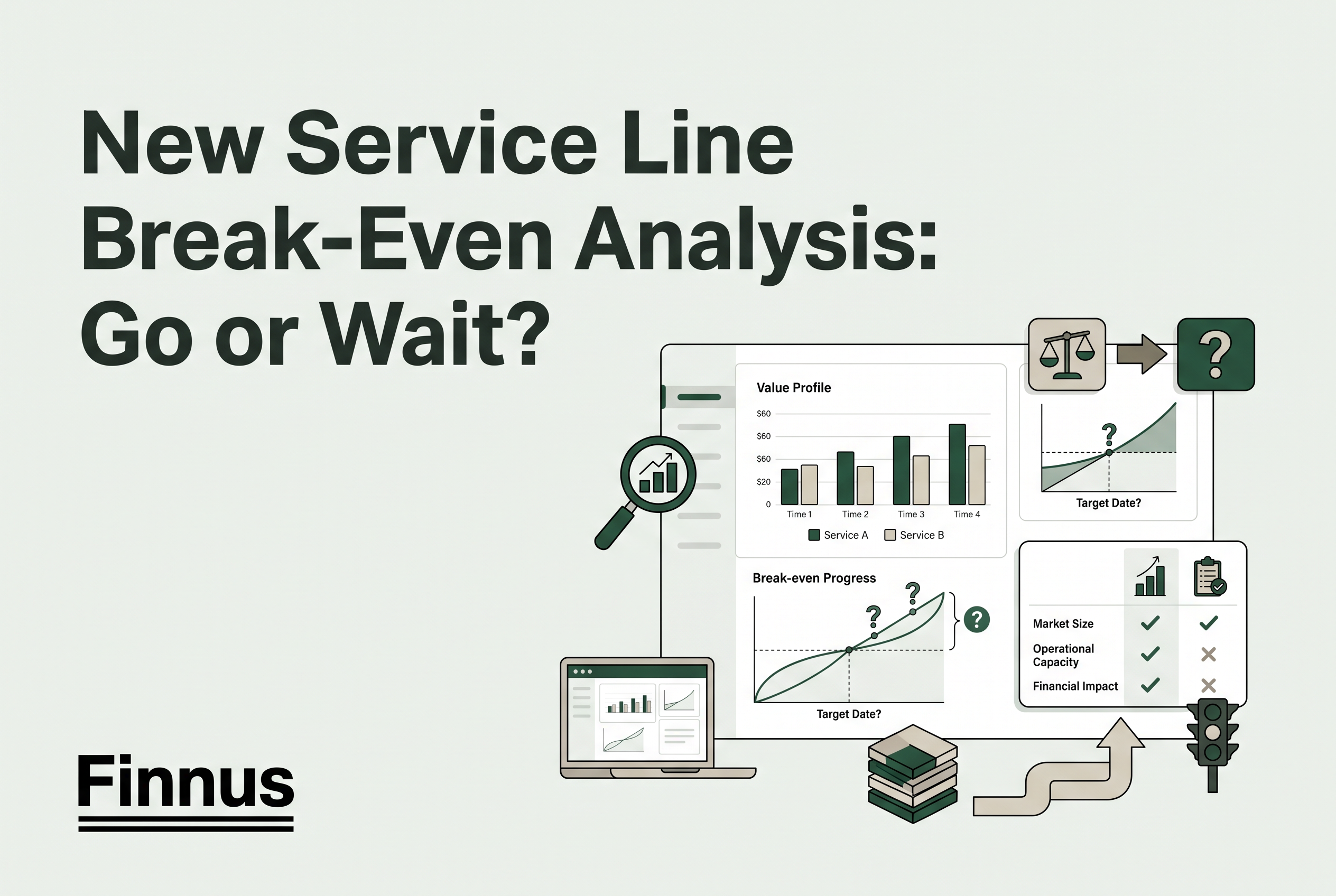
A new service line break-even analysis tells you how many jobs per month the line must win to cover its own new fixed costs, and how much cash you will burn before it gets there. Go if the line can plausibly reach that job count and you can fund the cumulative loss on the way. Wait if either answer is no.
Most owners stop at the textbook formula: fixed costs divided by contribution margin. That number is useful, but it isn't the decision. The decision is whether your bank balance survives the ramp. A plumber adding water treatment or an HVAC company adding indoor air quality can show a healthy break-even on paper and still run out of cash in month five.
This guide walks through the steps with one clearly illustrative example. All figures are hypothetical, built to show the method, not to predict your numbers.
What a new service line break-even analysis answers (and how it differs from adding a crew)
A new service line break-even analysis answers two questions: how many jobs per month cover the line's new fixed costs, and how much cash it needs before it gets there. The break-even month isn't the finish line. The largest cumulative cash shortfall before that month sets the funding you need.
This is different from adding a crew. A crew serves demand you already have, so the question is capacity: do you have enough booked work to keep another truck busy? If that's your question, read Service Business Capacity Planning: Know When to Add Another Crew. A new line sells something your customers don't yet buy from you. You're creating demand, not filling it, so you have new training, new marketing, new suppliers and an unknown close rate.
That's why the analysis must be incremental. Ask only what changes if you launch. Existing overhead stays out unless the new line actually raises it.
What does financial planning mean for a trade business?
Financial planning for a trade business means deciding in advance how you'll spend, earn and fund your next move, then checking it against real numbers. For a new service line, that means estimating added costs, expected jobs, ramp-up losses and how much cash you can safely commit. Break-even analysis is the core of it, because it turns a hopeful idea into a job count and a date you can accept or reject.
Step 1: List only the incremental fixed costs
Incremental fixed costs are the recurring monthly costs that exist only because you launched the line. Write each one down with a monthly figure.
Typical items for a trade business:
Dedicated or partly dedicated labor, such as a lead technician or a sales coordinator
Certifications, licenses and training
Equipment payments or lease costs
Marketing specific to the line (a landing page, direct mail, a service agreement offer)
Software, insurance and vehicle costs added by the line
Keep one-time launch costs in a separate list: initial tooling, inventory for the first jobs, branding, a demo unit. They don't belong in the monthly break-even, but they belong in the cash need.
Two rules keep this honest. First, don't allocate a slice of the office manager's salary unless you'll hire more admin because of the line. Second, do count the owner's time if it displaces something. If you'll spend ten hours a week selling the new line instead of quoting core work, price that trade-off, even if it isn't a payroll line.
How do I budget for a new service line?
Budget a new service line by listing only the costs that wouldn't exist without it: a lead tech's wages, a truck or equipment payment, added insurance, licenses, software and launch marketing. Leave out overhead you already pay. Total these as a monthly figure, add a cushion for slow early months, and compare the result to the extra gross profit the line must earn. That monthly figure becomes the budget you hold the new line to.
Step 2: Calculate contribution per job and break-even job volume
Contribution per job is the average price of a job minus the variable costs that scale with it, and break-even job volume is incremental fixed costs divided by that number.
The formula: break-even jobs per month = incremental monthly fixed costs ÷ (average job price − variable cost per job).
Variable costs for a trade job include materials, direct technician labor hours, truck and fuel time, permit fees, card processing, sales commission and warranty reserve. Use the true loaded cost of the hours, not the hourly wage.
The most common error is using your core-business margin. New lines rarely match it early on. Prices are set cautiously, jobs take longer because the crew is learning, and callbacks run higher. Use a lower margin than your mature lines for the first year.
The textbook method also assumes price and cost stay constant, that costs behave linearly, and that demand will show up at the calculated volume. None of that is guaranteed, which is why the next step matters. If you're still setting the price itself, Service Business Pricing Strategy: Raise Rates Without Losing Margin covers that decision.
Step 3: Model the ramp-up losses and working capital month by month
Ramp-up losses are the operating shortfall in every month before the line reaches break-even volume, and working capital is the cash tied up in receivables and inventory as jobs grow. Model both month by month, not as one annual average.
Build a simple 12-month grid with these rows: expected jobs, revenue, variable costs, fixed costs, monthly profit or loss, cumulative profit or loss. Then add the cash timing rows: when you pay for materials, when customers pay you, and any inventory you must hold.
Three details change the answer:
Ramp shape. New lines don't start at the steady-state job count. Assume a slow start, such as a few jobs in month one, growing toward target by month eight or ten.
Collection lag. Commercial or contractor-channel work may pay in 30 to 45 days while you buy materials immediately. That lag is cash you fund.
Cumulative low point. Find the month where cumulative cash is lowest. That figure, plus one-time launch costs and a contingency, is the cash you must have set aside before you start.
A line can be profitable by month nine and still need a cash cushion that peaks in month six. The grid shows you that. The formula alone doesn't.
How do I forecast a new service line without a finance team?
Forecast month by month in a simple spreadsheet. For each month, estimate jobs completed, revenue, direct costs and fixed costs, then track the running cash balance. Start with a low job count and let it climb slowly, since new lines rarely hit full volume right away. Use your own past job data where you have it, and label every guess as a guess. Update the sheet monthly with actuals so your forecast improves.
A worked example: go or wait? (illustrative numbers and assumptions)
Here's a hypothetical: an HVAC company with an established customer base adds an indoor air quality line. Every number below is invented to show the method.
Assumptions
Incremental fixed costs: $9,000 per month (a part-time comfort advisor at $4,500, marketing at $2,000, training and certification amortized at $1,000, equipment lease at $900, insurance and software at $600)
Average job price: $2,400
Variable cost per job: $1,500 (equipment and materials, loaded technician time, permit and processing costs)
Contribution per job: $900
One-time launch costs: $14,000 (demo equipment, initial inventory, website)
Customers pay about 30 days after completion
Break-even: $9,000 ÷ $900 = 10 jobs per month.
Ramp: jobs per month of 2, 3, 4, 5, 6, 7, 8, 9, 10, 10, 11, 12.
Monthly result is jobs × $900 − $9,000. Month one is −$7,200, month two −$6,300, then −$5,400, −$4,500, −$3,600, −$2,700, −$1,800, −$900, then $0 in month nine. Cumulative operating loss at its low point: about $32,400.
Add the $14,000 launch costs and roughly one month of receivables float (about $24,000 at peak early volume) and the cash need lands near $70,000, before any contingency. With a 15% buffer, call it $80,000.
Decision: the line breaks even at 10 jobs per month and reaches it in month nine. Is that plausible? The example assumes you can book 10 air quality jobs a month from your existing base. If you serve 1,500 active customers and expect 0.7% to buy per month, that's about 10 jobs. Plausible, but not obvious. The cash need is the real test. If $80,000 is available without touching payroll or tax reserves, go. If not, wait and fix funding first.
What are the basics of financial planning for business?
The basics are knowing what you earn per job, what your fixed costs are, how much cash you hold and how long a new move takes to pay back. Put those four numbers on one page, then test them against a slower, weaker scenario. If the plan still works when things go worse than hoped, it's sound. The worked example above shows how those four numbers drive a go or wait decision.
Stress-test the assumptions and set a written go-or-wait rule
Stress-testing means re-running the grid with worse inputs to see whether you can still survive. Do three runs, changing one thing at a time.
Slower demand: ramp takes 15 months instead of 9 months.
Lower price or margin: contribution drops from $900 to $700 per job.
Slower collections: customers pay in 60 days, not 30.
In the illustrative example, a $700 contribution lifts break-even from 10 jobs to about 13 jobs per month, which is above the 12 the ramp reaches by month twelve. The line would never break even inside the first year. That single result tells you more than the base case.
Then write the rule down before launch, so you aren't negotiating with yourself in month four. A usable rule has four parts:
Go if base-case break-even is reached within 12 months, the stressed case still breaks even within 18, and the full cash need (including contingency) is available without touching tax or payroll reserves.
Wait if any of those three fails.
Checkpoint: at month six, if actual jobs are below 60% of plan, pause new spending and review.
Kill rule: name the cumulative loss at which you stop. Set it now.
This is where an outside view helps. Finnus is an operating partner for owner-run businesses of roughly $5M to $30M in revenue, with monthly board meetings and a lasting record of decisions. A launch rule like this is exactly the kind of decision worth putting in front of someone who will ask about it at the month-six checkpoint.
What financial management tips help before a launch?
Write down your go-or-wait rule before you spend anything: the job volume, margin and cash cushion that must hold for you to proceed. Keep launch money separate from running-business cash. Test a slower ramp and a lower price, and review results monthly against your plan. Writing the rule first stops you from moving the goalposts later, and it gives you a clear, calm basis for stopping if the numbers miss.
Limits of break-even analysis and a pre-launch checklist
Break-even analysis has real limits. It assumes constant price and unit cost, fixed costs that stay fixed, and linear cost behavior. It says nothing about whether customers will buy, how competitors respond, or whether your crew can sell and install something new without hurting core service quality. It gets messy with multiple offers because it relies on a stable mix. Treat it as a floor for the discussion, not a forecast.
Before you launch, check:
Incremental fixed costs listed and separated from existing overhead
Contribution per job built from loaded costs, at a first-year margin
Break-even jobs compared with a realistic demand source (existing customers, leads, referral channels)
Month-by-month ramp with cumulative low point identified
One-time launch costs and receivables float added to the cash need
Three stress tests run
Go-or-wait rule, month-six checkpoint and kill rule written down
Cash sourced and confirmed, including contingency
If you also run a cash forecast for hiring, Cash Flow Forecast for Small Business: Plan Your Next Hire uses the same month-by-month logic and fits alongside this analysis.
What are good financial planning habits for business?
Good habits are durable, not trendy: plan with real job data, separate fixed from variable costs, model cash month by month, stress-test your assumptions, and set a written decision rule. Review actuals against the plan every month and record why you made each call. The checklist in this section applies these habits to a launch. Keep bookkeeping, tax and legal work with qualified professionals, since a planning model doesn't replace them.
FAQ: break-even questions owners ask
What financial statements do I need for this planning? Three: an income statement (profit by month), a cash flow statement (when money actually moves) and a balance sheet (receivables, inventory and debt). For a new line, the cash flow view matters most, because the ramp-up shortfall shows up there first.
How is break-even tied to funding requirements? Break-even tells you the target volume. Funding is the cumulative loss before you reach it, plus launch costs, working capital and a buffer. Size funding to the gap, not to the break-even month.
What does good budgeting and scenario planning look like here? One base case and at least three downside runs, each changing a single assumption, reviewed monthly against actuals. Revise as real job counts come in.
The FAQ below covers the short-form questions.
Write your go-or-wait rule before you spend a dollar
A new service line is a bet on demand you don't yet have, so the break-even job count is only half the answer. The other half is how much cash you burn before you get there and whether you have it. Build the incremental cost list, run the month-by-month ramp, stress it, and write the go-or-wait rule down. If you want an outside view on your numbers, bring the decision to a free 30-minute intro call with Finnus at finnus.ai and leave with a second opinion on whether to launch now or wait.
Frequently asked questions
How do you calculate break-even for a new service line?
Divide the line's incremental monthly fixed costs by contribution per job (average job price minus variable cost per job). The result is the number of jobs per month needed to cover the line's own costs. Then model the ramp month by month to find the cash needed before you reach that volume.
What is the purpose of a break-even analysis?
It shows the minimum volume at which a new line stops losing money and exposes how much cash it consumes before then. For a trade business it turns a gut-feel launch into a go-or-wait decision with explicit assumptions you can test and revisit.
What are the disadvantages of break-even analysis?
It assumes stable prices, constant unit costs and fixed costs that stay fixed, and it ignores demand, competition and customer behavior. Reaching the calculated volume is not guaranteed. Use stress tests and a month-by-month cash grid to cover what the formula cannot.
How much cash do I need before launching a new service line?
Add the largest cumulative operating loss from your ramp model, one-time launch costs, working capital tied up in receivables and inventory, and a contingency for delays. Finnus can help you pressure-test that figure with an outside view before you commit.
Talk it through with an operating partner who remembers every decision.
Book an intro call