Debt Service Coverage Ratio: Can You Afford Expansion?
November 13, 2026. Updated November 13, 2026
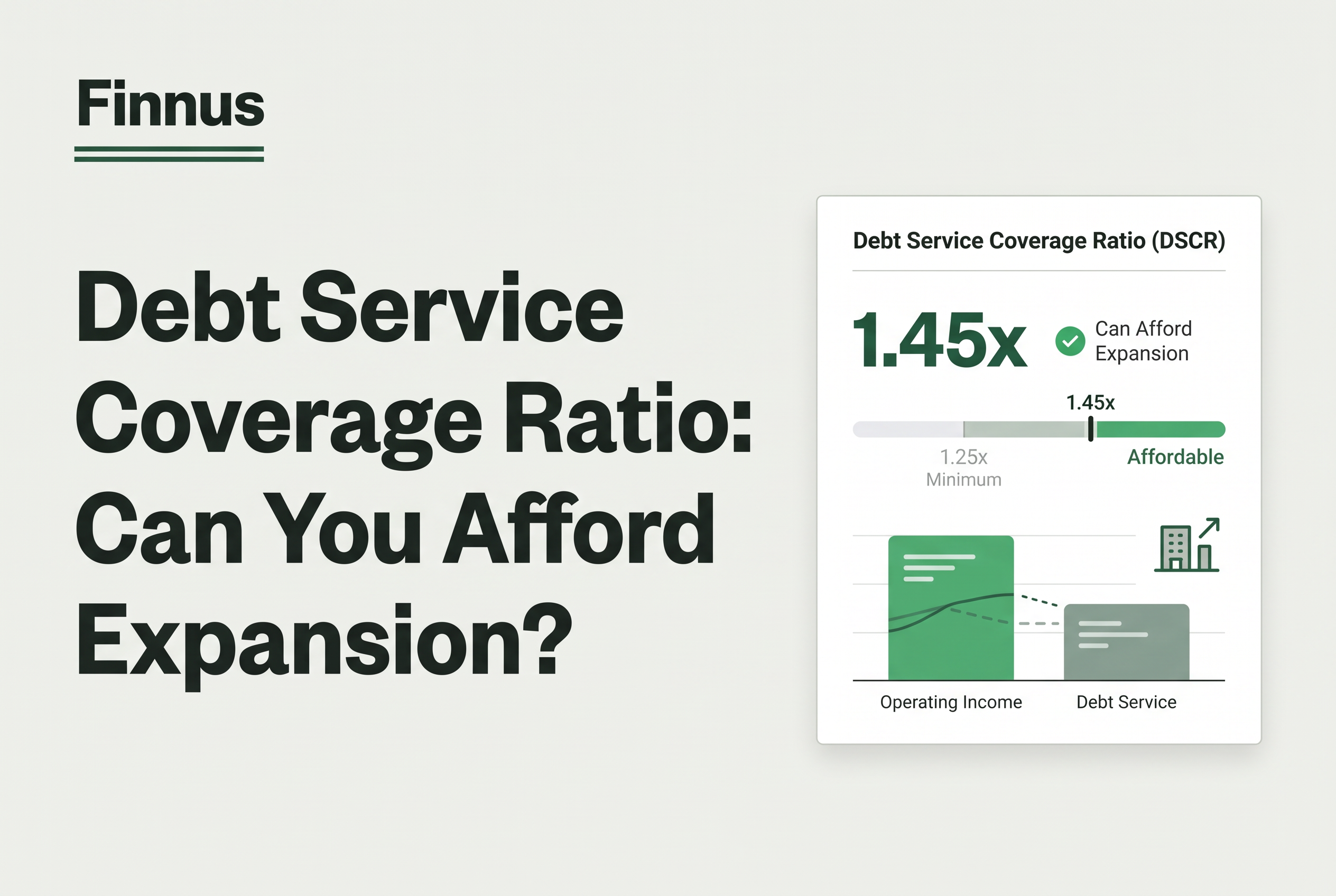
Your service business can afford an expansion loan when the operating cash it generates covers all debt payments, existing plus the new loan, with room left for a slow quarter. The debt service coverage ratio (DSCR) is the test: annual operating cash available divided by annual debt service. A result above 1.0x means the cash covers the payments on paper. Whether it covers them in February, after a bad month of callbacks, is a different question, and this post walks through both.
The example numbers here are illustrative. They show the mechanics, not what your lender will approve. Every lender sets its own minimum and its own way of adjusting your cash flow, so know your number before you walk into that conversation.
What debt service coverage ratio means for a service business (and how it differs from a property DSCR loan)
Debt service coverage ratio measures how many dollars of operating cash your business produces for each dollar of loan payments it owes. For an HVAC, plumbing, electrical or landscaping company, that is the question behind any loan for a new crew, truck fleet, location or service line.
This is not the same thing as a "DSCR loan" you see advertised for real estate. A DSCR rental-property loan is a loan on a non-owner-occupied rental, and the lender mostly compares the property's rent with its payments (often rent divided by PITIA for residential rentals, or net operating income divided by debt service for commercial property). The property qualifies the loan, not your personal income.
A business loan for expansion works differently. The lender looks at your company's cash flow, credit and collateral, and the DSCR is one test among several. The ratio you need here is built from your operating cash, not from rent. If you searched "how does a DSCR loan work" and landed on rental-property guides, set those aside. The formula looks similar, but the income being measured is different.
The formula: operating cash available divided by total debt service
DSCR equals net operating income (or lender-adjusted cash flow) divided by total debt service, using the same period for both, typically one year (Finnus summary of standard lending practice, 2026). Total debt service includes principal and interest on your existing debt and the proposed loan.
Illustrative example: $250,000 of annual operating cash divided by $200,000 of annual debt payments gives 1.25x. You have $1.25 available for every $1 of debt service.
Three rules for the numerator:
Start from real operating cash, not revenue. Revenue tells you nothing about repayment capacity. A $12M business with thin margins can have less room than a $6M business with healthy ones.
Add back non-cash items and owner extras honestly. Depreciation and one-time costs belong in. Personal expenses you cannot document do not.
Subtract what the business needs to keep running. Lenders adjust cash flow in different ways, and for SBA and small-business loans they may use adjusted EBITDA or another measure. Confirm the lender's method before you trust your own result.
The same logic answers a common search: how much can the business borrow? Work backward. Take annual operating cash, divide by the coverage ratio you want to hold, and what remains is the total annual debt service you can carry. Subtract your existing payments and the rest is room for the new loan. Revenue alone cannot answer this.
Build the debt schedule: existing plus proposed repayments (illustrative example)
A debt schedule lists every loan payment you owe over the year, existing and proposed, so that total debt service is a number you can see instead of a guess. Build it before you apply anywhere.
Here is an illustrative schedule for a $14M electrical and HVAC contractor adding a second install crew. These figures are invented to show the method.
| Obligation | Annual payment |
|---|---|
| Truck loans (existing) | $48,000 |
| Equipment loan (existing) | $36,000 |
| Line of credit interest (existing) | $18,000 |
| Proposed expansion loan | $72,000 |
| Total debt service | $174,000 |
Suppose operating cash available is $261,000. DSCR is $261,000 divided by $174,000, or 1.5x.
Now look at what the schedule exposes. Without the new loan, debt service is $102,000 and the ratio is about 2.6x. The expansion cuts your cushion by more than half. That is the real decision. The question isn't whether the ratio clears a bar. It's how much cushion you're trading for the crew.
Two mistakes to avoid. First, do not leave out payments that look small, such as vehicle leases or interest-only line payments. Second, do not count the new crew's revenue in the numerator yet. A new crew usually takes months to reach full billing, so the loan payment starts before the cash arrives. Run the ratio on today's cash first, then add expected new cash separately as an upside case. For a closer look at whether a new line can pay for itself, see New Service Line Break-Even Analysis: Go or Wait?.
Stress test it: seasonality, a slow quarter and a downside cash check
A ratio that passes on annual numbers can still fail in the worst quarter, so stress it before you sign. Annual DSCR hides timing, and loan payments are due monthly whether or not it rained in May.
Run three checks.
1. Seasonality. Split annual operating cash into months or quarters. A landscaping or HVAC business may earn most of its cash in two seasons. Line up the monthly debt payment against the slowest months. If a winter month produces less cash than the payment, you are funding the gap from reserves or a credit line.
2. A slow quarter. Reduce the operating cash expected in your weakest quarter, then rebuild the annual total and recompute coverage. Keep the quarterly decline separate from a full-year decline. As a separate annual stress case, a 25% reduction in annual operating cash takes $261,000 to $195,750, and annual DSCR falls to about 1.12x. Still above 1.0x, but thin. If your stress case lands under 1.0x, operating cash no longer covers the scheduled payments.
3. Downside cash. Ask how many months of total debt service your cash on hand covers if collections slow. Add the receivables you are waiting on and the materials you must buy before a job pays. This is where a ratio meets reality.
These checks work best against a live plan, not a one-time spreadsheet. A rolling forecast keeps the next twelve months current, and business scenario planning lets you decide in advance what you will do if cash dips, such as pausing a hire or drawing on the line.
What lenders look at and what to ask them (no universal cutoffs)
Lenders evaluate more than the ratio, and there is no single DSCR cutoff that applies everywhere. Requirements vary by lender and loan type, and SBA lenders may calculate cash flow using adjusted EBITDA or other adjustments, so confirm the method and the minimum with each lender you talk to.
Beyond DSCR, expect them to look at credit, collateral, time in business, existing debt, customer concentration and how the loan will be used. For a service business, a loan tied to a specific asset (a truck, equipment) often reads differently from working-capital money.
Questions to ask before you apply:
How do you define operating cash? Which adjustments and add-backs do you accept?
Which debt do you include in total debt service? Do you count leases and the line of credit at the limit or the balance?
What minimum coverage do you require for this product? Ask for the number for your loan type, not a general answer.
Do you test the ratio on historical or projected cash?
What reporting will you require after funding?
If you are comparing SBA 7(a) lenders on DSCR requirements, ask each one directly and compare in writing. The answers differ, and the lender's own number is the only one that counts. A related risk lenders notice: if one customer drives much of your cash, your coverage is less stable than the ratio suggests. See customer concentration risk.
Beyond the ratio: can you afford expansion given working capital and timing?
Clearing the coverage ratio does not mean you can fund the growth, because expansion consumes cash before it produces any. A new crew needs payroll, tools, insurance and materials weeks before its first invoice is collected, and your customers may pay on terms.
So test two more things. First, the working capital the new work will tie up: receivables, inventory and job costs. Our guide to working capital requirements shows how to size it. Second, the payback: is the loan worth it for the return? Estimate the added gross profit from the new crew or service line, subtract the added operating costs, and compare the result with the annual loan payment. If the added cash does not clearly exceed the payment within a realistic ramp period, the expansion is a bet on timing, not a plan.
This is where an outside view helps. Finnus gives owner-run businesses an experienced operating partner, monthly board meetings and a lasting decision record, so a decision like this one gets pressure-tested by someone who is not on your payroll. You bring the debt schedule and the stress cases. The board meeting is where you challenge the assumptions and agree on the trigger points. Finnus Board costs $999 per month with a three-month minimum, then month to month, and it starts with a free 30-minute intro call where you bring a decision and leave with an outside view.
Bring your debt schedule to a free Finnus intro call
Expansion is affordable when your cash covers every payment in your slowest quarter, not just on the annual average. Build the schedule, stress it, and ask each lender for its own definition of cash flow and its own minimum. Then take the numbers to someone who will challenge them. Book the free 30-minute intro call with Finnus at finnus.ai/review, bring the loan you are considering, and leave with an outside view before you sign.
Frequently asked questions
What is a good debt service coverage ratio?
There is no universal answer. Above 1.0x means operating cash covers debt payments on paper, and a higher number gives more cushion for slow months. The minimum a lender requires varies by lender and loan type, so ask each one for its number and how it defines cash flow. Stress your own ratio against a slow quarter.
How do you calculate debt service coverage ratio?
Divide annual operating cash (or the lender's adjusted cash flow) by total annual debt service, including principal and interest on existing debt and the proposed loan. For example, $250,000 of cash divided by $200,000 of payments is 1.25x. Use the same period for both figures, and confirm the lender's method.
How does a DSCR loan work, and how is it different from a business loan for expansion?
A DSCR rental-property loan qualifies a non-owner-occupied rental mainly on the property's rent compared with its payments. An expansion loan for your service business is judged on the company's operating cash, credit and collateral. Both use a coverage ratio, but they measure different income. Finnus helps you pressure-test the business version before you borrow.
What is the downside of a DSCR loan?
For rental-property DSCR loans, lenders often trade less personal income documentation for higher rates or larger down payments, and terms vary by lender. For a business expansion loan, the main risk is a thin cushion: payments start before new revenue does. Stress your ratio against seasonality and a slow quarter first.
Talk it through with an operating partner who remembers every decision.
Book an intro call