Overtime vs Hiring: Find the Break-Even Workload
November 6, 2026. Updated November 6, 2026
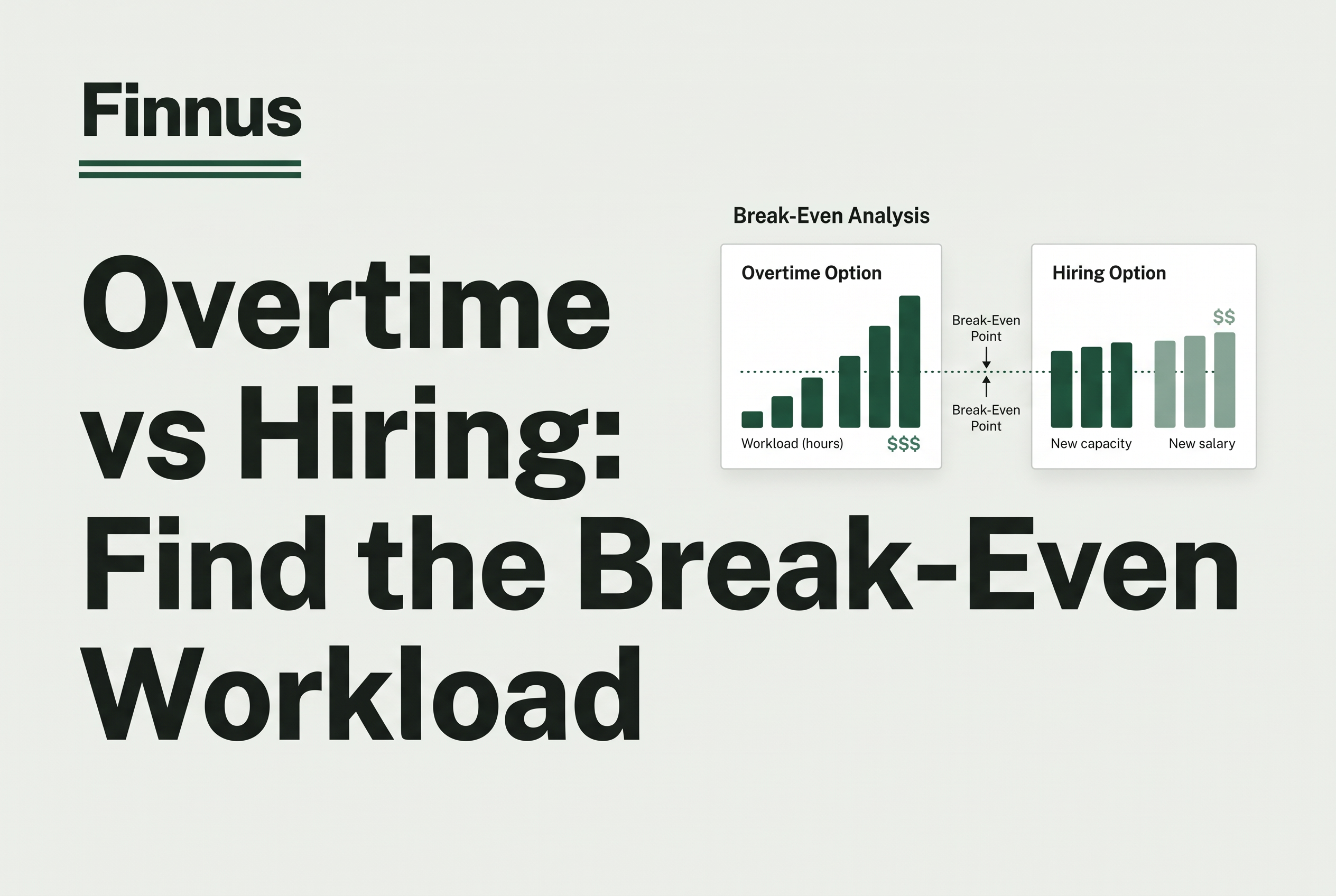
Overtime is usually cheaper than hiring for a short backlog, and hiring is usually cheaper once the same overtime hours repeat week after week for months. The crossover depends on four numbers: the overtime premium, the fully loaded cost of a new hire, the ramp-up period, and how long the demand will last.
This post works one break-even for an owner whose existing crew is already running overtime. Every figure below is an illustrative assumption chosen to show the method. It is not a customer result and not a benchmark. Swap in your own payroll numbers and the answer will move.
Finnus is an operating partner for owner-run businesses of roughly $5M to $30M revenue, with monthly board meetings and a lasting decision record. A hire like this is exactly the kind of decision it is built for.
Is it cheaper to pay overtime than to hire? It depends on four numbers
Overtime is cheaper for temporary work and a hire is cheaper for permanent work, and the four numbers tell you which one you have. They are the incremental cost of an overtime hour, the fully loaded annual cost of one added employee, the unproductive months while that person ramps up, and the number of weeks the extra demand will actually last.
Most owners compare an overtime hourly rate to a new hire's hourly wage. That comparison is wrong on both sides. Overtime has its own hidden costs, and a hire costs far more than the wage. The rest of this post builds each side honestly, then puts them against each other.
One framing note: you are choosing between 'overtime' and 'a person' only on the surface. What you're really choosing is the cheapest way to buy a fixed number of productive hours per week for a known period.
How does financial planning apply to the overtime-or-hire choice?
Financial planning here means putting numbers behind a staffing choice before you act. Estimate what overtime costs now, what one added employee costs fully loaded, how much work is steady, and how fast cash comes back. Those four inputs turn a gut feeling into a decision you can explain and revisit. Finnus works with owner-run businesses of roughly $5M to $30M revenue on decisions like this one.
What overtime really costs: the federal rule and the incremental math
Under the federal Fair Labor Standards Act, non-exempt employees must be paid at least one and a half times their regular rate for hours worked over 40 in a workweek (U.S. Department of Labor, 2026). That is the federal floor. Your state may add daily overtime or other rules, and some of your crew may be exempt or paid under different arrangements. Confirm your own situation with your payroll provider or an employment attorney rather than relying on a blog post.
The incremental math is where owners go wrong. An overtime hour does not cost 1.5 times the wage. It costs 1.5 times the wage plus the employer payroll taxes that scale with pay, plus any workers' compensation premium that is calculated on payroll. It does not usually add health insurance or paid time off, because those do not scale with extra hours.
Illustrative assumption: a technician earns $30 an hour. Overtime pay is $45. Add an assumed 10% for employer payroll taxes and payroll-based insurance, and the incremental cost is about $49.50 per overtime hour.
Then adjust for productivity. A tired technician at hour 48 is not as productive as at hour 20. If we assume overtime hours are 85% as productive as regular hours, the cost per productive overtime hour is $49.50 divided by 0.85, or about $58.24. That is your overtime number.
What one new hire really costs: fully loaded, plus onboarding and ramp-up
A new hire costs the wage plus taxes, insurance, benefits, tools, vehicle, training and the months before that person works at full speed. Add all of it before you compare.
Illustrative assumptions for one additional technician at $30 an hour on 2,080 paid hours:
Wages: $62,400 a year.
Employer payroll taxes and payroll-based insurance at 10%: $6,240.
Health and other benefits: $9,000.
Truck, fuel, tools, uniform and phone: $12,000.
Paid time off, holidays and sick days are already inside the 2,080 paid hours, but only about 1,800 of them are productive field hours.
That is $89,640 a year fully loaded, or about $49.80 per productive hour at 1,800 hours, before ramp-up.
Now add ramp-up. Assume a one-time hiring cost of $4,000 for recruiting and onboarding, plus three months where the new hire is only 50% productive while a senior tech spends time training. The lost output is roughly 3 months at half productivity, about 225 productive hours of paid time that produces nothing. At $49.80 an hour that is about $11,200 of ramp-up drag. Total first-year cost lands near $104,800 for about 1,575 productive hours, or roughly $66.50 per productive hour in year one. In year two, with no ramp-up, it falls back to the $49.80 range, before raises.
How do I put a new hire into the budget?
Add the hire as its own budget line with every cost attached: wages, payroll taxes, benefits, insurance, tools, truck or vehicle, training and the weeks of reduced output while they learn. Then subtract the overtime premium you expect to stop paying. Plan the monthly net figure, not the annual salary alone, so you can see the impact on cash and margin in each month.
A worked break-even: overtime hours per week vs one added employee
Using the assumptions above, overtime costs about $58.24 per productive hour and a mature hire costs about $49.80, so the hire wins on unit cost once you are past ramp-up. The catch is that a hire is a fixed cost you pay whether or not there is work.
So test the break-even on volume. Suppose your crew works 30 hours of overtime a week in total.
Overtime route: 30 hours at $49.50 is $1,485 a week, about $77,200 a year if it runs 52 weeks. Those hours produce 25.5 productive hours a week.
Hire route: $89,640 a year plus $15,200 of one-time and ramp-up cost in year one is about $104,800, producing roughly 1,575 productive hours.
To match the 1,575 productive hours with overtime you would need about 1,853 overtime hours at 85% productivity, costing roughly $91,700. So in year one, with ramp-up included, the two routes land close together at this volume: about $91,700 for overtime against about $104,800 for the hire. In year two, the hire is clearly cheaper: $89,640 against roughly $91,700, and the gap widens with more hours.
The practical rule from these numbers: below about 20 overtime hours a week across the crew, overtime is cheaper through year one, because one hire's fixed cost cannot be absorbed. Above about 35 hours a week that persists, the hire is cheaper in year one and wins by more every year after. Between those two, it is a judgment call that the next two sections settle.
These thresholds move with your wage, benefits and productivity assumptions. Recompute them with your numbers. For the surrounding capacity question, see service business capacity planning.
How do I scenario plan a hire against overtime?
Build three budget cases: a low-demand case, a base case and a high-demand case. In each one, compare the cost of the overtime hours you would still pay against the fully loaded cost of one added employee. Change one input at a time, such as weekly overtime hours, billable rate or ramp-up weeks, so you can see which number moves the answer most. Keep the cases on one page and revisit them each quarter.
Backlog or sustained demand? Test it before you hire
A backlog is work you can clear and finish. Sustained demand is work that keeps arriving at the same pace after the backlog is gone. The break-even only favors a hire for the second kind.
Run three checks before you post the job:
Subtract the backlog. List scheduled jobs that are one-time catch-up, such as a storm surge, a delayed install season or a competitor's closure. If removing them drops overtime below roughly 20 hours a week, you have a backlog problem, not a headcount problem.
Look at inflow, not just the schedule. Count new booked work per week over the last 8 to 12 weeks. Is it flat or rising after the surge, or falling back?
Check what is recurring. Maintenance agreements and repeat customers support a permanent hire. One-off projects do not.
If demand is a backlog, buy flexibility instead: planned overtime with a cap, a subcontractor for the peak, or a seasonal hire with a defined end. If it is sustained, the fixed cost of a hire is the cheaper way to buy the hours.
How do I forecast demand before adding headcount?
Start with booked jobs, maintenance agreements and recurring work, then add a conservative estimate of new work based on past seasons. Compare that forecast with the hours your crew can deliver without overtime. If steady demand fills a full-time role across the slow months too, the hire is supported. If the work is a one-time backlog, cover it with overtime or subcontractors and forecast again in a quarter.
Cash timing: when the money leaves and when it comes back
A hire's costs start on day one and the revenue arrives later, so a profitable hire can still strain cash. Model the timing, not just the annual total.
Payroll goes out every pay period starting the first week. The new hire's billable output ramps over roughly three months, and your customers then pay on your terms, perhaps 30 days for commercial accounts. Using the assumptions above, you could carry something like $25,000 to $35,000 more cash out than in during the first quarter before the hire pays for itself. Overtime, by contrast, is paid only as hours are worked and produces billable work immediately, so it needs less cash up front.
Build a simple weekly forecast with the hire's cost on one line and the extra billings, delayed by your payment terms, on another. If the low point goes below your cash floor, you have three options: stage the hire, collect deposits, or cover the gap with overtime during ramp-up. The same method is laid out in cash flow forecast for small business: plan your next hire, and customer deposits can shorten the gap.
How do I find break-even and the cash I need to fund a hire?
Break-even is the point where added revenue or avoided overtime covers the new hire's full monthly cost. Funding need is the cash you spend before that point: wages and onboarding start immediately, while billings from that person arrive weeks later. Add up the monthly gap during ramp-up and keep that amount in reserve or available on a credit line. If the gap would strain payroll, delay the hire or phase it in.
When overtime stops being worth it: quality, burnout and turnover signals
Overtime stops being worth it when the cost shows up outside payroll: callbacks, safety incidents, missed appointments and people quitting. These do not appear in the unit math above, and they are why the 85% productivity figure is an assumption you should test, not trust.
Watch for these signals:
Callback or rework rate rising compared with the same weeks last year.
Overtime concentrated on the same two or three people, week after week.
Late arrivals, short tempers and sick days increasing among those people.
A strong technician giving notice or hinting at it.
The last one is the most expensive. Replacing a good technician costs recruiting, onboarding and ramp-up all over again, and it pushes the remaining crew into even more overtime. If your best people are carrying the extra hours, assume the 85% figure is optimistic and rerun the break-even at 75%. At 75%, overtime costs about $66 per productive hour, higher than the first-year cost of a hire.
Make the decision and record it
Make the decision with a one-page comparison: your overtime cost per productive hour, the hire's fully loaded year-one and year-two cost per productive hour, the backlog test result, the cash low point, and the quality signals. Then write down which route you chose and what would change your mind.
The record matters. Six months from now you will want to know whether you assumed 35 sustained overtime hours or 20, and what you expected the new hire to produce. A written decision lets you check that expectation against reality instead of remembering it kindly.
Set a trigger in advance, for example: 'If overtime stays above 30 hours a week for six more weeks and inbound bookings hold, post the job.' A rule you wrote before you were tired is easier to follow than a judgment you make at 9 p.m. in peak season.
Which financial statements do I need before deciding to hire?
Use three statements. The income statement shows whether margins can absorb a new wage. The cash flow statement shows whether you can fund the months before the hire pays for itself. The balance sheet shows your cash, receivables and debt, which set how much risk you can carry. Pull the last three years if you have them, since trends in overtime and labor cost matter more than a single month.
Bring your overtime numbers to a free 30-minute intro call
Overtime wins when the work is a backlog, and a hire wins when the same hours keep coming back. The only way to know which you have is to run your own wage, benefits, ramp-up and cash numbers through the break-even. If you have a hire you are deciding on, book a free 30-minute intro call with Finnus. Bring the decision and leave with an outside view from an experienced operating partner, then keep it on record through Finnus's monthly board meetings.
Frequently asked questions
Is it cheaper to pay overtime than to hire?
For short-term backlogs, yes. In the illustrative example here, overtime costs about $58 per productive hour against about $50 for a mature hire, but the hire's fixed cost and ramp-up make overtime cheaper below roughly 20 extra hours a week. Once those hours persist, the hire usually wins. Finnus helps owners run this comparison with their own numbers.
At what point does overtime become not worth it?
Overtime stops being worth it when the extra hours are sustained rather than temporary, or when quality, callbacks, burnout or turnover begin to rise. In the example here, persistent overtime above about 35 hours a week crosses over in favor of a hire in year one. Test your own crossover with your wages and productivity.
How much does a $20 an hour employee cost an employer?
Far more than $20. Wages for 2,080 hours are about $41,600, and employer payroll taxes, insurance, benefits, tools, vehicle and training can add a large share on top, plus ramp-up months of reduced output. Add each line for your business, then divide by productive hours, not paid hours.
Is overtime 40 or 45 hours?
Under the federal Fair Labor Standards Act, overtime for non-exempt employees applies to hours over 40 in a workweek (U.S. Department of Labor, 2026). Some states have additional daily or weekly rules. Check your state's requirements and your employees' classifications with your payroll provider or an employment attorney.
Should I hire for a temporary backlog?
Usually not. Subtract one-time catch-up work from your overtime hours first. If what remains is under about 20 hours a week, use capped overtime, a subcontractor or a seasonal hire instead. A permanent hire fits sustained demand backed by recurring customers. A free 30-minute intro call with Finnus can pressure-test the decision.
Talk it through with an operating partner who remembers every decision.
Book an intro call