Rolling Forecast: Update the Plan Without Moving the Goal
November 12, 2026. Updated November 12, 2026
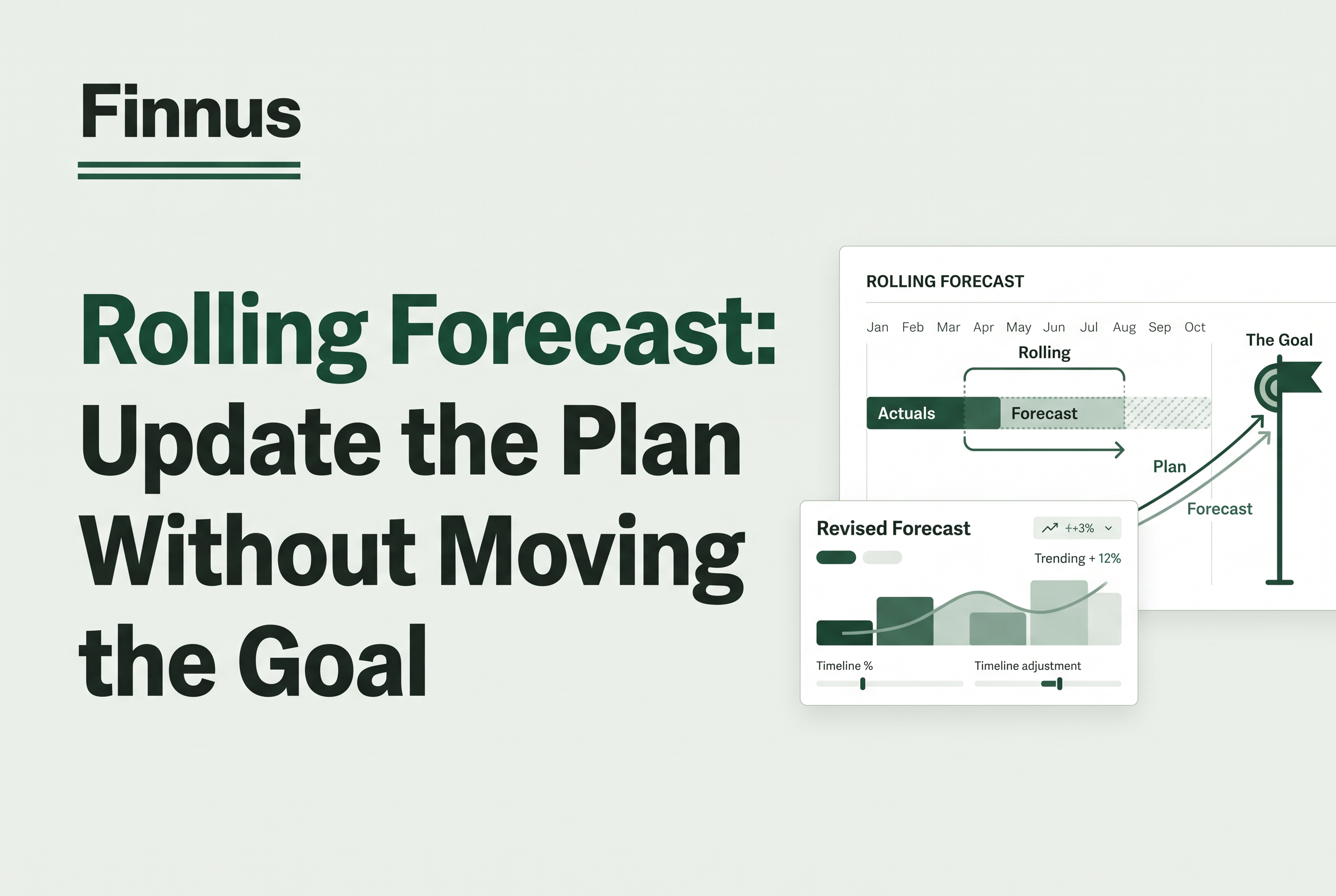
A rolling forecast is a projection that always looks the same distance ahead: when a month closes, you swap its forecast for actual results, drop it, and add a new month at the far end. For an owner-run service business, the outlook stays current while the annual budget stays put as the yardstick you are held to.
Most owners with a $5M to $30M HVAC, plumbing, electrical, landscaping or roofing company already have a budget. By March it is stale. Weather shifted a season, a lead tech quit, a supplier raised prices. The temptation is to quietly edit the budget so the variances look better. Don't. Keep the budget frozen and run a rolling forecast beside it. This post shows the monthly routine, a worked example, and how to keep it going.
What a rolling forecast is (and how it differs from your budget)
A rolling forecast is a financial projection with a constant forward horizon, usually 12 months, that you revise on a regular cadence as actual results arrive. The definition is simple. The discipline is in the roll: each close replaces a forecast month with actuals and adds a new month at the end.
A budget is different. It is set before the year starts and does not move, so its remaining horizon shrinks every month. By October you are planning two months ahead with a document written the previous winter.
Use both. The budget is your target and accountability record. The rolling forecast is your best current guess about what will actually happen. When they diverge, that gap is information. It isn't an embarrassment.
The monthly update in four moves: actuals in, month added, drivers revised, assumptions noted
The monthly update takes four moves, in this order, and should fit in an afternoon once your books close reliably.
1. Actuals in. Replace the closed month's forecast with real revenue, costs and cash from your books. Do not blend or adjust. Actuals overwrite the forecast.
2. Month added. Drop the closed month from the front and add a new month at the end, so the forecast still covers the next 12 months. Seed the new month from the same month last year, adjusted for your current drivers.
3. Drivers revised. Change only the assumptions that new evidence has moved: booked jobs, technician count, average ticket, material costs. If nothing changed, leave it alone. Rewriting every line each month is how forecasts become a chore people abandon.
4. Assumptions noted. For every material change, write one line on what changed and why. In six months, those notes tell you which assumptions you consistently get wrong.
Then compare three views: actuals against budget, current forecast against budget, and current forecast against last month's forecast. The last one shows whether your judgment is drifting.
Worked example: a 12-month rolling forecast for an illustrative HVAC company (not a customer outcome)
Here is a hypothetical HVAC company. These numbers are invented to show the mechanics and are not a customer result.
The budget was set in December: $10.2M annual revenue, with 11 technicians, an average service ticket of $410 and a summer spike in install work. It is frozen.
It is now the end of June. Here is the update:
| Item | Budget (frozen) | Prior forecast | Updated forecast |
|---|---|---|---|
| June revenue | $1,050,000 | $1,010,000 | $955,000 (actual) |
| Technicians on payroll, Jul to Dec | 11 | 11 | 10 |
| Average ticket | $410 | $410 | $425 |
| Gross margin on installs | 34% | 33% | 31% |
| Full-year revenue | $10,200,000 | $9,900,000 | $9,650,000 |
Actuals in: June came in at $955,000, below both budget and the prior forecast. A heat-wave backlog slipped into July because one technician left.
Month added: June 2026 drops off the front. June of next year goes on the end, seeded from this year's June at the new technician count.
Drivers revised: Headcount drops to 10 until a hire lands. Average ticket rises to $425 after a price increase. Install margin falls to 31% because equipment costs rose.
Assumptions noted: "Lost one technician in June; backfill assumed September. Equipment cost up about 3 points; not yet passed through on installs."
The budget still says $10.2M. The forecast says $9.65M. That $550,000 gap is the conversation to have at your next review, with the reasons written down.
Keep the original budget frozen as your accountability baseline
Freeze the budget because a baseline that moves can't hold anyone accountable. If you reset targets every time reality disagrees, every variance shrinks to zero and you learn nothing about how good your original plan was.
The rule: change the budget only through a deliberate replan, a conscious decision recorded as such. Never make a quiet edit in the spreadsheet. Everything else flows through the forecast.
This split also settles a common argument. When a manager says "we're on track," ask which document they mean. On track against the budget is a performance statement. On track against the forecast is a prediction statement. They are different claims.
For what to do when actuals miss the budget, see Budget Variance Review: When to Change the Spending Plan. That post covers the decision about spending. This one covers keeping the outlook current.
Revenue drivers and expense assumptions worth updating in a service business
Model a handful of drivers, not every account. In a service business, a few inputs explain most of the result.
Revenue drivers
Booked and scheduled jobs for the next 60 to 90 days
Technician or crew count and billable utilization
Average ticket or average job size
Maintenance agreement count and renewal rate (see Maintenance Contract Profitability: Reprice or Renew?)
Seasonal timing: when the peak actually starts this year
Expense assumptions
Labor: headcount, overtime hours, planned hires (see Overtime vs Hiring: Find the Break-Even Workload)
Materials and equipment cost as a percent of revenue
Fuel, insurance and vehicle costs
Owner distributions, if you plan them
Each driver gets one owner: the person who knows the number best. Dispatch owns jobs booked. The service manager owns utilization. You own pricing. Without named owners, driver updates become guesses made in a meeting.
How to build one in Excel or a spreadsheet, and how it differs from a cash forecast, variance review and downside scenarios
To create a rolling forecast in Excel, build one workbook with a tab for drivers, a tab for the 12-month forecast, and a tab holding the frozen budget.
Drivers tab: one row per driver, with the current value, the owner, and a notes column.
Forecast tab: 12 monthly columns. Revenue and expense lines reference the drivers tab. Closed months hold pasted actuals, formatted differently so nobody mistakes them for estimates.
Budget tab: a locked copy of the original plan. Protect the sheet.
Comparison rows: forecast minus budget, and this month's forecast minus last month's.
Monthly roll: save a dated copy, paste actuals over the closed month, add a column for the new month, update drivers, add notes.
A spreadsheet is enough. Dependable bookkeeping and a repeatable routine matter more than extra detail.
This is not the same as the other planning tools:
Cash flow forecast: tracks timing of money in and out, week by week. The rolling forecast is on a profit basis over 12 months. Use both; see Cash Flow Forecast for Small Business: Plan Your Next Hire.
Budget variance review: explains why actuals missed the plan and decides whether spending should change.
Downside scenarios: test what happens if a bad case hits and set triggers in advance; see Business Scenario Planning: Set Cash Decision Triggers.
The rolling forecast is your single best-guess case. The scenarios are the ranges around it.
Rolling forecast FAQ: types of forecasting, the steps, and how often to update
What are the three types of forecasting?
Common groupings are qualitative forecasting (judgment from people who know the business), time-series forecasting (projecting from past patterns such as last year's seasonality), and causal forecasting (linking results to drivers like headcount or booked jobs). A good owner-run rolling forecast mixes all three: history for seasonality, drivers for the math, judgment for what changed.
What are the steps to forecasting?
Pick a horizon and cadence, gather actuals, identify the few drivers that explain results, update the assumptions that new evidence changed, reforecast revenue, costs and cash, replace the closed month with actuals and add a new one, then review variances and refine. The four-move monthly update above is that process compressed into a routine.
How do you do a cash flow projection?
Start with your opening cash balance. Project collections from open invoices and booked work, then subtract payroll, supplier payments, taxes, loan payments and distributions on the dates they actually leave the account. Roll the ending balance into the next period. Check the low point, not just the total.
How often should you update a rolling forecast?
Monthly, right after your books close, if closes are reliable. If they aren't, use a cadence your team can sustain. A forecast updated every month beats a detailed one updated twice a year.
What does financial planning mean for a business, and what belongs in a plan?
Financial planning is setting targets, projecting results and cash, and deciding what to do about the gaps. A working plan has an income statement view (profit), a cash flow view (timing), and a balance sheet view (what you own and owe, including receivables and working capital; see Working Capital Requirements: Can You Fund More Sales?). The budget sets the goal, the rolling forecast keeps it honest, and 3 to 5 year projections give direction. Keep the long-range view simple and revisit it annually.
Making the monthly forecast stick: who owns each driver and how Finnus Board's monthly meeting and decision record help
Forecasts die when nobody is accountable for updating them or acting on the gap. The fix is a standing meeting, named driver owners, and a written record of what you decided.
Finnus Board is an experienced operating partner, monthly board meetings and a lasting decision record that help owner-run businesses turn plans into action. It is built for businesses of roughly $5M to $30M in revenue. In practice, the monthly meeting is where the four moves land: the updated forecast goes on the table, the partner pushes on the assumptions that moved, and the decisions that follow (hire, reprice, hold spending) go into the record alongside the reasons. Business Memory means next quarter's meeting starts from what you said last time, not from scratch. Finn prepares the work ahead of the meeting. The human partner provides the outside view and the accountability.
The record matters for this routine in particular. Your assumption notes say what you believed. The decision record says what you did about it. Together they show, a year later, whether the forecast was right and whether you acted on it. For a meeting structure to borrow, see Monthly Business Review Agenda: Turn Decisions Into Action.
Freeze the budget, roll the forecast, and bring one decision to Finnus
The goal should hold still while the outlook moves. Lock the budget, run the four-move update after every close, and put a name on every driver. That one habit turns a stale annual plan into a monthly decision tool. If you want an outside view on your own gap between budget and forecast, book the free 30-minute intro call with Finnus, bring one decision you're weighing, and leave with a second opinion from an operating partner. Finnus Board is $999/month with a three-month minimum, then month to month.
Frequently asked questions
What is the definition of a rolling forecast?
A rolling forecast is a financial projection that keeps a constant forward horizon, typically 12 months. Each time a month closes, you replace its forecast with actual results, drop it, and add a new month at the end. It runs alongside a fixed budget rather than replacing it.
How do I create a rolling forecast in Excel?
Build three tabs: drivers (jobs, headcount, average ticket, margins, each with an owner), a 12-month forecast that references the drivers, and a locked copy of the budget. Each month, paste actuals over the closed month, add a new month, revise changed drivers, and log why.
Should I replace my annual budget with a rolling forecast?
No. Keep the original budget frozen as your accountability baseline and run the rolling forecast beside it. The budget tells you how you performed against the plan; the forecast tells you where you are headed. Change the budget only through a deliberate, recorded replan.
How can Finnus help me keep a rolling forecast current?
Finnus Board gives owner-run businesses a human operating partner, a monthly board meeting and a decision record. Your updated forecast becomes the meeting's starting point, and the decisions and assumptions behind it are recorded so they carry into the next month.
Talk it through with an operating partner who remembers every decision.
Book an intro call