Business Scenario Planning: Set Cash Decision Triggers
November 10, 2026. Updated November 10, 2026
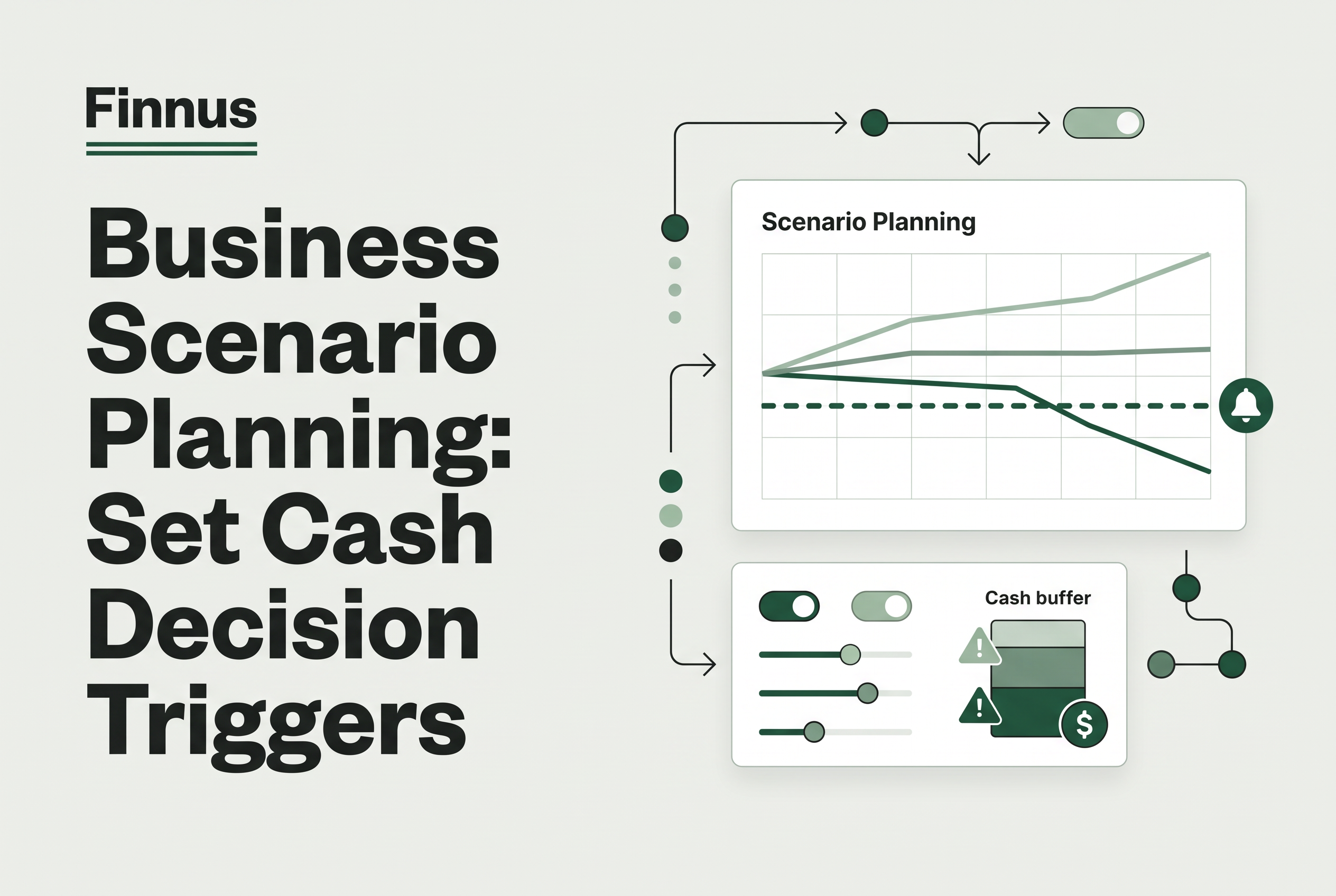
Business scenario planning means taking the annual plan you already have, rerunning it under tougher assumptions, and deciding in advance what you will do if cash drops toward a floor you set. For an established service business, the useful version is built on cash, not accounting profit, and ends with triggers: if projected cash falls below the floor within a set number of weeks, a named person does a named thing by a named date.
That is the whole idea. The rest of this article shows how to do it with three cases built from one plan, using illustrative figures that are clearly labelled and not benchmarks for your business. Your numbers will differ, and they should drive every threshold you set.
What business scenario planning is (and what it is not): stress-testing a plan you already have
Business scenario planning is a stress test of your existing annual plan. It is not a second plan and not a prediction. You keep the budget you already built, change a few assumptions that could realistically hurt cash, and see what happens to the bank balance week by week.
It is not forecasting the future with more decimal places. A forecast says what you expect. A scenario asks what you would do if something else happened. The value is in the decision you make before the pressure arrives, when you are calm, rather than the one you improvise when payroll is eight days out.
It is also not a strategy offsite. Skip the workshop on global trends. Pick the two or three uncertainties that move cash in a service business: how fast customers pay, how much work lands, and what you have already committed to pay out. Everything else is noise for this exercise.
Use one model for all cases. If the base case and the downside live in different spreadsheets, you cannot trace a cash gap back to the assumption that caused it.
Cash vs. accounting profit: why a profitable plan can still run out of cash
A plan can show a healthy profit and still run out of cash. Profit counts a job when you earn it, and cash counts it when the customer pays. In a service business, the gap between those two dates is where trouble lives.
Consider the timing. You pay technicians every two weeks, buy materials at the start of a job, and invoice at completion. The customer pays in 30, 45 or 60 days. On the income statement the job is profit the day you invoice. In the bank account, you have funded it for weeks. Growth makes this worse, because every new job needs cash up front before it returns any.
Other items sit outside profit entirely: loan principal, equipment purchases, owner distributions, tax payments and inventory. None of them is an expense on the income statement in the way it hits the bank.
So build your scenarios on a cash view. Start with cleared cash today, then lay out expected receipts and payments by the week they are likely to land. A rolling 13-week view works well for the near term. If you are weighing a hire against the cash it needs, the cash flow forecast for small business guide walks through that forecast.
What financial management tips matter most for owners?
Watch cash, not just profit. Forecast it weekly for the next 13 weeks, chase receivables on a fixed schedule, and know the lowest balance you can run before payroll becomes a risk. Separate what you owe from what you have collected so a profitable month does not hide a cash gap. Keep a short written record of each big decision and the numbers behind it, so you can learn from it later.
Build three cases from one plan: base, downside and severe downside (illustrative figures, labelled, with a table)
Build three cases from a single plan by changing only the assumptions that drive cash: collections timing, revenue volume and fixed obligations. Keep the base case grounded in current trends and commitments. Make each downside a coherent story, not a random cut to every line.
The figures below are illustrative only. They describe a hypothetical owner-run service business and are not benchmarks. Replace every number with your own.
| Assumption (illustrative) | Base | Downside | Severe downside |
|---|---|---|---|
| Average days to collect | 35 | 50 | 65 |
| Monthly revenue vs. plan | 100% | 90% | 75% |
| Largest customer pays | On time | 3 weeks late | 6 weeks late |
| Biweekly payroll | $120,000 | $120,000 | $120,000 |
| Opening cash | $450,000 | $450,000 | $450,000 |
| Lowest projected cash | $310,000 | $175,000 | $40,000 |
| Week of lowest point | 9 | 8 | 7 |
| Minimum cash floor | $200,000 | $200,000 | $200,000 |
Read the table from the bottom. In this hypothetical, the base case never touches the floor. The downside dips below it around week 8. The severe downside breaches it by week 6 or so and bottoms out in week 7, well under the floor.
Notice what did not change: payroll. Payroll is a commitment, and that is the point. Revenue and collections flex. Payroll does not, at least not quickly. The stress comes from the mismatch.
Tell each case as a story. Downside: your biggest customer slips three weeks while work softens a little. Severe downside: that customer slips six weeks, other customers stretch too, and volume falls by a quarter. If you cannot say it in two sentences, the case is too complicated to act on.
What are the best practices for budgeting and scenario planning?
Start from the budget you already have, then change only the few assumptions that can hurt cash: collection days, job volume and payroll timing. Keep to three cases (base, downside, severe downside), label every figure as an assumption, and set a minimum cash floor before you run them. Review the cases against actuals every month so the plan stays current. A scenario that no one revisits is just a spreadsheet.
Model the pressure points: collections delays, payroll obligations and your minimum cash floor
Three pressure points decide whether you survive a bad stretch: collections delays, payroll obligations and your minimum cash floor. Model each explicitly.
Collections delays. Do not shift every invoice by the same number of days. Slow your largest customers first, because that is how it really happens. One slow payer on a big contract hurts more than ten slightly slow small ones. Check how much of your receivables sits with your top few accounts. If it is a lot, see customer concentration risk.
Payroll obligations. List payroll dates, payroll taxes and benefit payments by week. Add other fixed commitments: rent, loan payments, insurance, equipment leases. These are the outflows that do not bend when revenue does.
Minimum cash floor. The floor is the lowest balance you are willing to run, and it should come from your own obligations and risk, not a rule of thumb. One way to set it: add up the essential payments you must cover over a stretch you choose, such as payroll and rent for the next few weeks, and add a cushion for surprises. Write the number down and the logic behind it. If you take owner distributions, tie them to the floor too. The owner distributions guide covers that.
Then do the one calculation that matters: find the lowest closing cash in each case and the first week it crosses the floor. That date is your warning time, and it sets how early your triggers must fire.
Turn each scenario into decision triggers: if cash is projected below the floor within X weeks, do Y (with owner and deadline)
A decision trigger is a pre-agreed rule. If projected cash falls below the floor within a set number of weeks, a specific person takes a specific action by a specific date. Write the rule now, while nothing is wrong, so you are not negotiating with yourself during a crunch.
Each trigger needs four parts: the condition, the action, the owner, and the deadline. Here are illustrative examples. The week counts and actions are placeholders for you to replace.
| Trigger (illustrative) | Action | Owner | Deadline |
|---|---|---|---|
| Projected cash below floor within 8 weeks | Call every customer with overdue invoices; offer a payment date | Office manager | Within 3 business days |
| Projected cash below floor within 6 weeks | Pause discretionary spend and non-urgent purchases | Owner | Same week |
| Projected cash below floor within 4 weeks | Pause owner distributions; delay equipment buys | Owner | Immediately |
| Projected cash below floor within 3 weeks | Draw on credit line or talk to your lender | Owner | Within 2 business days |
Match the trigger to the case. Triggers at 8 and 6 weeks are built for the downside. The 4 and 3 week triggers are built for the severe downside. Order them from cheap and reversible to expensive and painful, so you try the easy moves first.
One rule keeps this honest: every trigger has a single owner. "We will look at it" is not a trigger. If a collections call needs making, a name goes in the table.
Some actions have trade-offs worth thinking through ahead of time. Offering a discount to collect faster costs margin, so read early payment discount before you put it in a trigger. Asking for deposits is another lever. See customer deposits.
Which financial planning strategies work for small businesses?
The strategies that work are simple and repeatable: set a cash floor, run a base and a downside case, and attach a specific action, owner and deadline to each warning sign. Typical actions include pausing a hire, tightening payment terms, delaying a purchase or drawing on a credit line. Decide these steps in advance and you act early and calmly, rather than reacting once cash is already short.
Keep scenarios alive: review against actuals monthly and use your cash forecast and budget variance review
Scenarios go stale in about a month unless you compare them with what actually happened. Review them monthly against actuals, update the assumptions, and roll the forecast forward.
A simple monthly routine works. First, compare actual cash receipts and payments with the base case. Second, ask which assumption was off: collection days, volume, or a one-time payment you missed. Third, move the downside and severe downside to match, and recheck the lowest cash point and the week it occurs. Fourth, confirm whether any trigger has fired or is close.
When actual collections run slower than your base case for two or three weeks, do not wait for the quarter to end. That is your early signal that you are drifting toward the downside. The budget variance review guide explains when a variance means change the spending plan and when it is just timing.
Keep a record of each trigger decision and what happened after. Over a few months, that record shows you which assumptions you tend to get wrong, which makes the next round of scenarios sharper. A monthly business review agenda is a good place to hold this check so it does not slip.
What are the best practices for business financial planning?
Treat the plan as a monthly routine, not an annual event. Compare actual results to budget each month, explain the gaps, and update your cash forecast before you commit to hiring, pricing or equipment spending. Pair that with written decision triggers, such as a defined action if projected cash falls below your floor within a set number of weeks. Plans that get reviewed against real numbers are the ones owners actually use.
Answering common questions: the 5 steps of the scenario planning process, how to create a scenario plan, and examples of business scenarios
What are the 5 steps of the scenario planning process?
There is no single official list, but a practical five-step version for cash looks like this: (1) set your forecast horizon and starting cash, (2) pick the few uncertainties that move cash, (3) write explicit assumptions for a base, downside and severe downside case, (4) find the lowest balance and the week it occurs against your cash floor, and (5) set triggers with owners and deadlines, then review monthly.
How do I create a scenario plan?
Start from your existing annual plan, not a blank page. Convert it to a weekly cash view, copy it twice, and change only the assumptions tied to your chosen uncertainties. Calculate closing cash for each week, flag the first week each case falls below your floor, then write the triggers. Keep one model so every change is traceable.
What are some examples of business scenarios?
For an established service business, useful cash scenarios include a major customer paying three to six weeks late, a seasonal slowdown cutting booked work, a supplier tightening payment terms, an unexpected equipment failure, or losing a large recurring contract. Pick scenarios that are plausible for your customers and your commitments, not dramatic ones.
How does this connect to wider financial planning?
Scenario planning sits on top of the basics: a budget, a cash flow forecast and your core statements (income statement, cash flow statement and balance sheet). Break-even analysis and funding needs feed the downside cases, since they tell you how much volume you need and how much cushion you would draw on. For a specific decision example, see new service line break-even analysis.
Put an outside view on your triggers: bring one decision to a free 30-minute intro call with Finnus
Finnus gives owner-run businesses an experienced operating partner, monthly board meetings and a lasting decision record to turn plans into action and build business value. For this exercise, the useful part is accountability. A trigger only works if someone outside your own head asks whether you followed it.
The tools you will see mentioned for financial planning, such as spreadsheets like Excel and Google Sheets, or software like QuickBooks and NetSuite, help you build the model. They do not decide your cash floor, set the owner and deadline on each trigger, or challenge you when a trigger fires and you want to wait. A human operating partner fills that gap, with Finn preparing the work.
The free 30-minute intro call is built for this. Bring one decision, such as where your cash floor should sit or whether a trigger is set too late, and leave with an outside view. For ongoing support, Finnus Board is $999 a month with a three-month minimum, then month to month, and includes monthly board meetings, quarterly 90-minute strategy sessions, Business Memory, a tracked value roadmap and partner answers within two business days.
Write your triggers before you need them
A scenario you have not turned into a trigger is just a worry. The point of business scenario planning is to decide now, on a calm day, who does what when projected cash crosses your floor. Pick your floor, run the three cases off your current plan, and write four triggers with an owner and a deadline each. Then bring your most uncertain one to the free 30-minute intro call with Finnus at finnus.ai and leave with an outside view on whether it fires early enough.
Frequently asked questions
What is business scenario planning?
Business scenario planning is stress-testing a plan you already have by rerunning it under tougher assumptions, such as late customer payments or slower work, and checking what happens to cash. For service businesses, it works best on a cash view and ends with pre-agreed triggers that name what the owner does and by when.
How do I set a minimum cash floor?
Base it on your own obligations, not a universal percentage. Add up essential payments such as payroll, rent and loan payments over a stretch you choose, add a cushion for surprises, and write down the logic. Revisit the number monthly as commitments change. Finnus can pressure-test your floor on a free 30-minute intro call.
Why can a profitable business run out of cash?
Profit counts revenue when you earn it, while cash counts it when the customer pays. If you fund payroll and materials weeks before invoices are paid, growth can drain the bank even as profit rises. Loan principal, taxes, equipment and distributions also hit cash without appearing as expenses.
How often should I update my scenarios?
Review them monthly against actual receipts and payments, and update assumptions that proved wrong. If you run a rolling 13-week forecast, refresh it weekly. Move the downside cases when actual collections drift from the base case, and check whether any trigger has fired or is close.
Talk it through with an operating partner who remembers every decision.
Book an intro call