Financial Planning for Business: Connect Profit and Cash
November 14, 2026. Updated November 14, 2026
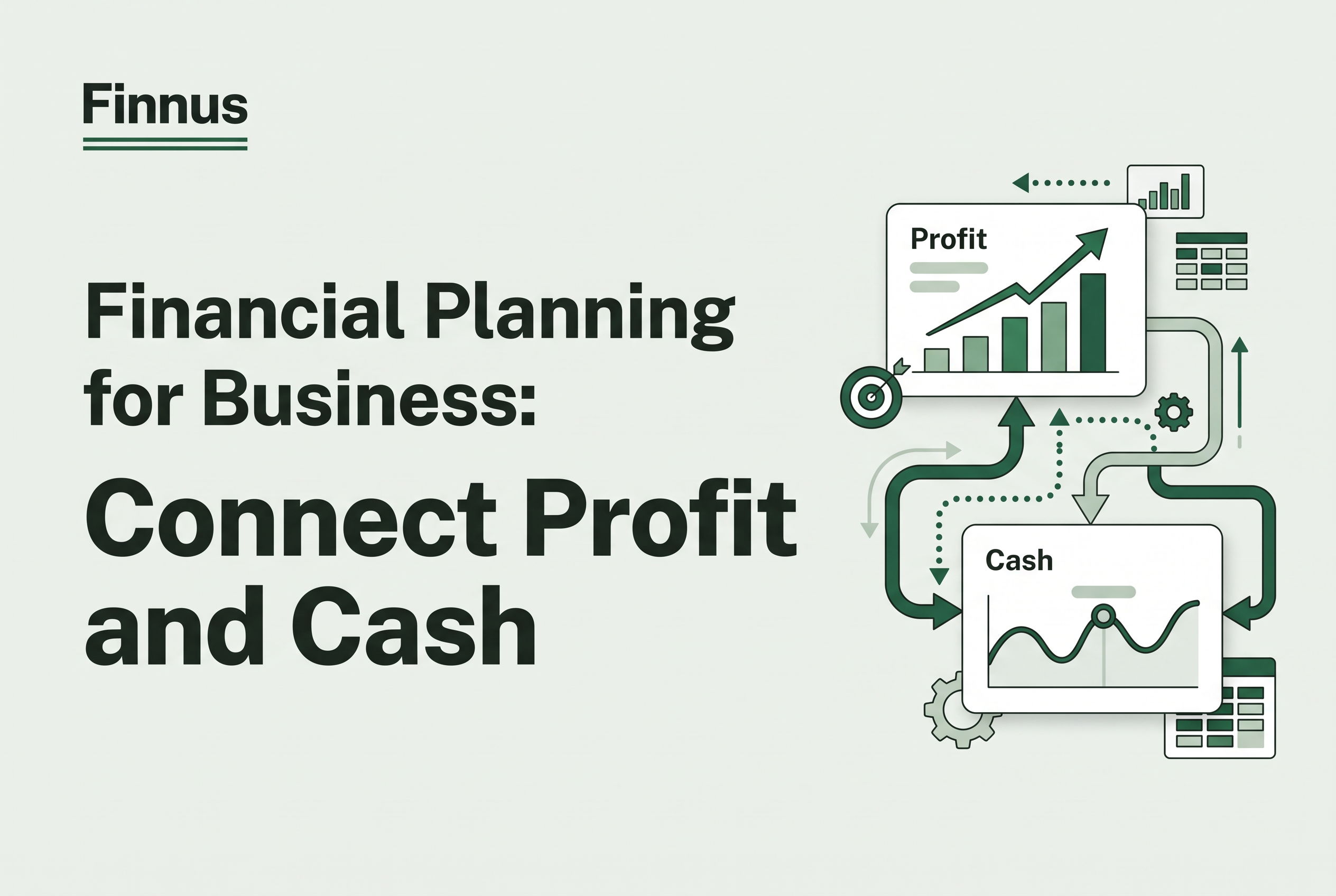
Financial planning for business means linking your income statement, balance sheet and cash forecast through written assumptions, then using that one plan to make hiring, pricing, equipment and expansion decisions every month. Done well, it answers one question before you commit money: what happens to profit, assets and cash if we do this?
Most guides list the parts separately: a budget here, a cash flow statement there, a note about taxes. So many owner-run service businesses end up with three spreadsheets that disagree. This post shows how to connect them for an established US service business doing roughly $5M to $30M in revenue, and how to keep the plan in use after the first month. All examples are hypothetical.
What financial planning for a business actually is (and the six steps behind it)
Financial planning in a business is a repeatable process that turns goals into projected profit, balance sheet position and cash, and then into decisions. In a formal business plan, it is the section that proves the goals are affordable: projected income statement, balance sheet and cash flow, plus the assumptions behind them. Profit does not pay payroll. Cash does.
The six steps used to create a financial plan, translated for a trades or service company:
Set goals. Revenue, margin, crew count, owner pay. Put numbers and dates on them.
Gather your baseline. Last three years of financials, current receivables, payables, debt and equipment.
Forecast revenue and expenses. Build from drivers like jobs per crew, average ticket and labor hours, not from a flat growth percentage.
Build the three linked statements. Income statement, balance sheet and cash forecast, covered in the next section.
Plan financing. Working capital, debt and owner distributions.
Monitor and adjust. Compare actuals to plan monthly and change decisions, not just the spreadsheet.
Business owners often add tax planning, risk management and succession to this list, and they belong in the plan. The order matters: goals first, statements second, decisions last.
For projections, use a 12-month monthly view for decisions and a three to five year annual view for direction. The near-term view should be precise. The long view only needs to be honest about its assumptions.
How the income statement, balance sheet and cash forecast link together
The three statements are one system. The income statement shows what you earned, the balance sheet shows what you own and owe, and the cash forecast shows when money actually moves. A change in one must show up in the other two.
Take a hypothetical $12M HVAC company that adds two install crews. Walk the change through each statement:
Income statement: Revenue rises as crews book jobs. Payroll, vehicle costs and materials rise first, so margin dips for a few months before it improves.
Balance sheet: Two new vans become fixed assets. Receivables grow because bigger installs bill on terms. Inventory grows because you stock more equipment. If financed, a loan appears on the liability side.
Cash forecast: Cash leaves for payroll and materials weeks before customers pay. The van down payments and loan payments hit immediately.
The income statement alone says the expansion is profitable. The cash forecast may say you run short in month three. That gap is why a budget by itself is not a plan.
The link points are few. Net income flows to retained earnings. Receivables and payables days drive the timing of cash. Capital purchases and loan payments sit between profit and cash. Build those connections and the three statements stop contradicting each other.
For the cash side in detail, see our walkthrough on a cash flow forecast for small business. Once the plan exists, a rolling forecast keeps it current without moving your goals.
Write down the assumptions that drive the plan
Written assumptions make the numbers in a business financial plan defensible, and most owners skip them. An assumption is any input you are guessing at: close rate, average ticket, technician utilization, days to collect, material cost inflation, seasonality.
Write each one in a single list with three columns: the number, where it came from, and when you will check it. A hypothetical row might read: "Collection time on commercial invoices: 45 days, from trailing 12 months of receivables, review quarterly."
Three rules keep the list useful:
Drive the model from a few levers. Driver-based planning, where a small set of business drivers directly moves performance, beats line-by-line guessing. For a service company, that usually means jobs per week, average ticket, labor cost per hour and days to collect.
Separate facts from bets. Your payroll rate is a fact. Next summer's demand is a bet. Mark them differently.
Pair the base case with downside triggers. Decide in advance what number, if missed, changes your plan. That is what business scenario planning is for.
When results miss the plan, the assumption list tells you why. Without it, you only know that you missed.
Plan financing: working capital, debt and owner distributions
Financing is where profit turns into a cash problem or a cash cushion, so plan it explicitly across three buckets: working capital, debt and owner distributions.
Working capital. Growth eats cash before it produces any. If you bill on terms and pay crews weekly, every added dollar of revenue needs funding in the gap. Cash flow planning that centers on liquidity, including receivables, payables and inventory, is a core planning practice. Our guide to working capital requirements shows how to test whether you can fund more sales.
Debt. Equipment and vehicle loans belong in all three statements: the asset and liability on the balance sheet, interest in the income statement, principal and interest in cash. Before you borrow, check whether operating cash can carry the payments. The debt service coverage ratio is the standard test.
Owner distributions. Treat owner pay and distributions as a planned line, not whatever is left in the account. Set a minimum cash floor first, then distribute above it. See owner distributions for how to set that floor.
A good financing section answers three questions in writing: how much cash must we hold, how much can we borrow and repay, and how much can the owner take out without breaking the plan?
Turn the plan into monthly decisions
A financial plan only matters if it changes what you do next month. The best practice is a short monthly review that compares actuals to plan, updates the forecast and ends with named decisions.
A workable monthly sequence for an owner-run service business:
Close the books and compare to plan. Revenue, gross margin, cash balance, receivables aging.
Find the variance cause. Was it volume, price, labor hours or collection speed? Check it against your assumption list. A structured budget variance review helps you decide whether to fix the operation or the plan.
Update the forecast. Roll the next 12 months forward.
Decide. Hire or use overtime? Reprice? Repair or replace a truck? Each of these maps to a lever in the plan. See overtime vs hiring, service business pricing strategy and equipment replacement.
Write the decision down. Record what you decided, the assumption behind it and the number that would make you revisit it.
Step five is the one that gets dropped. Six months later, nobody remembers why you hired the third estimator or delayed the truck purchase. Our monthly business review agenda lays out a meeting structure that builds this habit.
Keep the plan alive: DIY, bookkeeper or CPA, and an operating partner like Finnus
Most financial plans fail from neglect, not bad math. Someone builds a model in January and by April nobody opens it. Who keeps the plan alive matters more than which tool builds it.
Here is how the common options compare on what an owner of a $5M to $30M service business needs:
| Option | Strong at | Typical gap |
|---|---|---|
| DIY spreadsheet | Full control, no added cost | Depends entirely on your time and discipline; assumptions drift |
| Bookkeeper | Accurate, timely books | Usually records history rather than testing future decisions |
| CPA | Tax planning, compliance, year-end | Often engaged once or twice a year, not monthly |
| Operating partner (Finnus) | Monthly accountability and a lasting record of decisions | A different job from bookkeeping, tax or legal work |
You likely need accurate books and tax advice regardless. The question is who sits across the table from you each month asking whether the plan still matches reality.
Finnus gives owner-run businesses an experienced operating partner, monthly board meetings and a lasting decision record, so plans turn into action and build business value. In practice that means a human partner, with Finn preparing the work, who holds you to the decisions you wrote down. Finnus Board includes monthly board meetings, quarterly 90-minute strategy sessions, Business Memory, a tracked value roadmap and partner answers within two business days. It costs $999 a month with a three-month minimum, then month to month. Finnus is not a broker, takes no commission or fee on a future sale and does not buy businesses, so its advice has no sale incentive behind it.
If you want to test the fit first, the entry step is a free 30-minute intro call. Bring one decision and leave with an outside view.
FAQ: tracking small business finances and whether planners are worth it
How do you keep track of finances for a small business? Keep business money in separate accounts, record every transaction in bookkeeping software weekly, reconcile monthly, and review three numbers each month: cash balance, receivables aging and margin by job type. Then compare them to your plan, not just to last year.
What is the 70/20/10 rule for money? It is a personal budgeting rule of thumb: about 70% to spending, 20% to savings and 10% to debt or giving. It is not a business planning method. Businesses should plan from drivers, margins and cash timing instead.
How do I do my own financial planning? Set goals, gather three years of financials, build a driver-based forecast, link the income statement, balance sheet and cash forecast, write down assumptions and review monthly. The method works. The hard part is consistency, which is where a bookkeeper, CPA or operating partner helps.
Are financial planners actually worth it? They are worth it when they change decisions. A planner who delivers a document once a year adds little. One who reviews the plan monthly, challenges assumptions and records decisions can prevent expensive mistakes, like funding growth that cash cannot carry.
Start with one linked plan and one monthly decision
Financial planning for business works when profit, balance sheet and cash tell one story, the assumptions are written down and someone makes you act on the plan every month. Build the linked statements, list your assumptions, plan your financing and hold a monthly review. If you want an outside partner to keep that rhythm, book Finnus's free 30-minute intro call at finnus.ai, bring one real decision and leave with an outside view.
Frequently asked questions
What are the components of a business financial plan?
A business financial plan has a projected income statement, balance sheet and cash flow forecast, plus written assumptions, a financing plan covering working capital, debt and owner distributions, and a monthly review process. The three statements must link, so a change in one shows up in the others.
What are the six steps used to create a financial plan?
Set goals, gather your baseline financials, forecast revenue and expenses, build the linked income statement, balance sheet and cash forecast, plan financing, then monitor and adjust monthly. The sequence matters: goals come first, statements second, decisions last.
How do you forecast revenue, expenses and cash flow for a business?
Forecast from drivers such as jobs per crew, average ticket, labor hours and days to collect. Revenue and expenses feed the income statement, timing assumptions feed receivables and payables, and the cash forecast shows when money moves. Update monthly using a rolling forecast so it stays current.
How does Finnus help with financial planning for a service business?
Finnus gives owner-run businesses an experienced operating partner, monthly board meetings and a lasting decision record. It keeps your plan in use by turning it into monthly decisions you can track. Finnus Board is $999 a month with a three-month minimum, and the entry step is a free 30-minute intro call.
Talk it through with an operating partner who remembers every decision.
Book an intro call